Instant
01 · Ask
Ask the AI a follow-up
Got more questions about condensation & Mould Treatment? Describe the bit you're unsure about — the AI explains options, sequencing and what to ask the damp proofer.

Diagnose ventilation, insulation and heating — fix the root cause, not the dot on the wall.
You've read the brief on condensation & Mould Treatment. Now lean on us to find the right damp proofer — and stay in control of the job.
Got more questions about condensation & Mould Treatment? Describe the bit you're unsure about — the AI explains options, sequencing and what to ask the damp proofer.
Costs, timelines, pitfalls and the right questions to ask before any damp proofer starts on condensation & Mould Treatment.
Itemised quotes from up to 3 local damp proofers on condensation & Mould Treatment — so you can compare like-for-like, not lump sums.
Ready when you are
Enter your postcode and get free quotes from local pros.
Four moves that separate a smooth job from a nightmare.
Mould returns within months. Always biocide-treat first.
Tenants turn off extractor in winter to save energy. Result: condensation. Continuous low-rate ventilation (dMEV) better.
Cheap PIV in one room. Effective PIV is loft-mounted and ventilates whole house.
Condensation often misdiagnosed as rising damp. Survey carefully — condensation is much cheaper to fix.
Indicative UK ranges and what affects price.
By job type
Quote spread is typically ± 18% — always get 3 quotes.
Damp Proofer quick-view
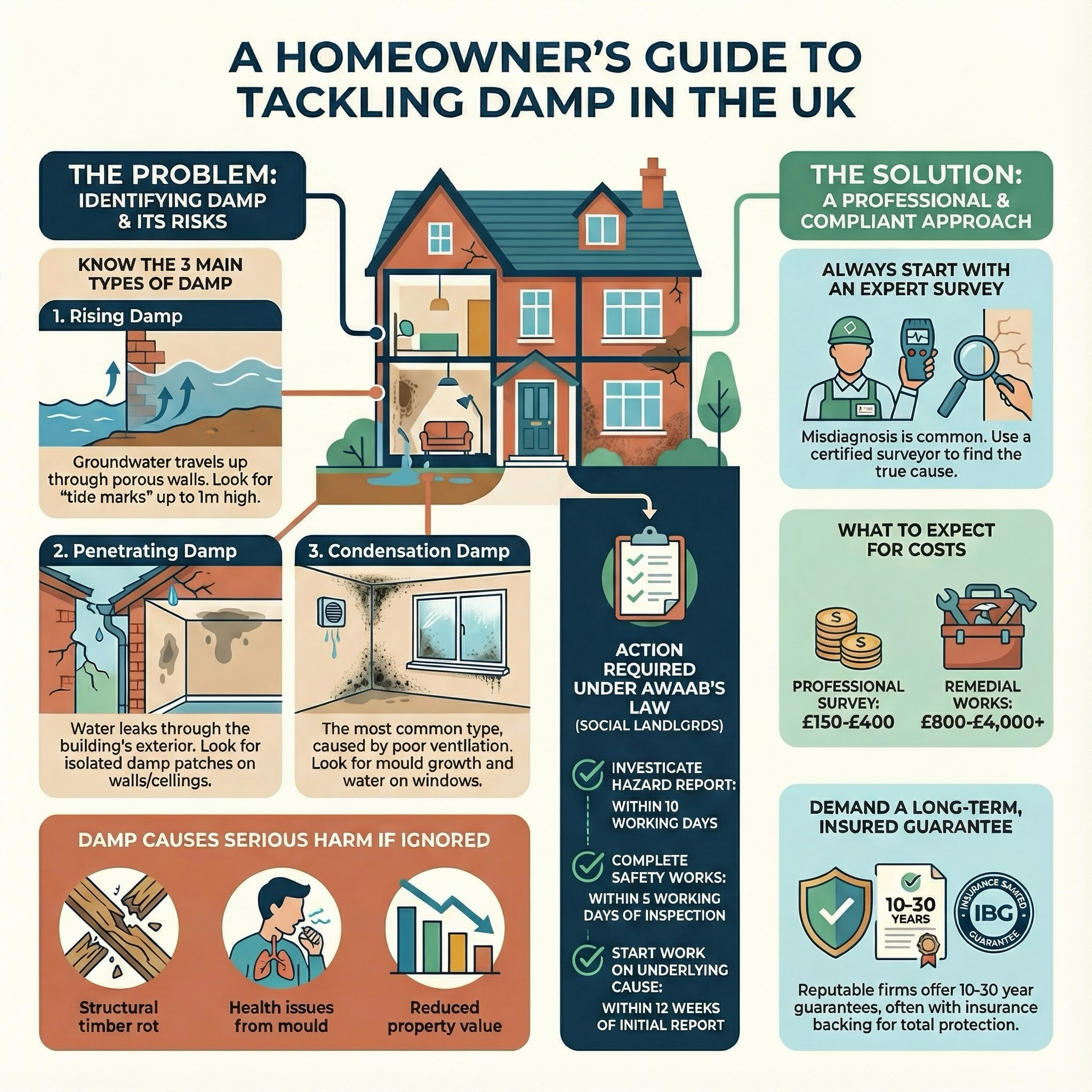
Damp Proofer explained
Condensation is the most common UK damp problem and the cause of most "black mould" complaints. The new Awaab's Law (2026) requires landlords to address it within strict timeframes. Expect to pay £80–£3,500 for UK condensation treatment depending on scope.
Cause analysis: humidity sources (cooking, bathing, drying clothes), ventilation, insulation cold-bridges. Remediation: extractor fans in bathroom and kitchen (PIV, MEV or dMEV), positive input ventilation (PIV) for whole house, sometimes MVHR (mechanical ventilation with heat recovery) for premium properties. Address cold-bridges with insulation upgrade. Black mould treated with biocide (Polycell, HG, Ronseal Anti-Mould).
| Item | Low (£) | High (£) | Notes |
|---|---|---|---|
| Mould treatment per area | 40 | 250 | Biocide + redecoration |
| Bathroom extractor (humidistat) | 150 | 400 | Vent-Axia, Greenwood |
| Kitchen extractor (continuous) | 200 | 500 | dMEV unit |
| PIV (positive input ventilation) | 500 | 1,200 | Whole-house, loft-mounted |
| MVHR full system | 2,500 | 6,500 | Premium, whole-house |
| Cold-bridge insulation per m² | 30 | 80 | Internal insulation |
| Damp survey | 120 | 400 | PCA-qualified |
| Anti-mould paint upgrade | +£40 | +£150 | Per room |
Bathroom extractor install: 2–4 hours. PIV install: half a day. MVHR: 3–5 days. Mould treatment + redecoration: 1–2 days per room.
Mould treatment with biocide: DIY. Extractor fans: electrician (Part P certified). PIV and MVHR: specialist installers.
For condensation: ventilation specialist (Nuaire PIV approved, Vent-Axia trained). For underlying damp: PCA-qualified surveyor. For landlord work: insist on Awaab's Law compliant timescales.
Awaab's Law 2026: landlords must address mould in social/private rented housing within strict timeframes (typically 7–14 days for serious cases). Building Regs Part F: minimum ventilation rates. Part L: thermal performance affects condensation.
Black mould on cold walls (especially north-facing, around windows), high humidity, water on windows in morning, mould in corners and behind furniture. Tide marks at low level are rising/penetrating damp, not condensation.
Condensation: cold-spot mould, top-down patterns. Rising damp: bottom-up tide marks, salt deposits. Penetrating damp: localised internal damp from external source. Easy to confuse — get diagnosis.
Bathroom and kitchen extractors are essential. For whole-house, add PIV (positive input ventilation, £500–£1,200) or MVHR (£2,500–£6,500). Don't expect single bathroom fan to fix whole-house issue.
UK 2026 legislation requiring landlords to address damp and mould within strict timeframes (typically 7–14 days for serious cases). Failure to comply can result in fines and tenant compensation.
No — paint is a symptom-treater. The underlying ventilation or insulation issue must be fixed. Anti-mould paint slows re-appearance but doesn't prevent.
Counterintuitively: improved ventilation can save money. Dry air heats more efficiently than damp air. MVHR can save 20–30% on heating in well-sealed homes.
This guide was written with AI assistance and is intended for general information only. Prices are estimates based on UK averages and may vary by region. Always get at least three quotes and consult a qualified professional before starting any work.
Ask follow-ups in plain English. The AI explains options, sequencing and what to ask the damp proofer — so you walk in informed.
Dry rot ( Serpula lacrymans ) is one of the most serious threats to UK homes. Unlike wet rot, dry rot has the unique ability to spread through masonry and plast...
READ GUIDE →GuideEmergency damp proofing is a critical intervention for UK homeowners facing sudden moisture ingress or structural failure. Left unchecked, damp can lead to timb...
READ GUIDE →GuideStructural waterproofing is the specialised process of protecting a building's foundations and below-ground spaces from groundwater ingress. For UK homeowners, ...
READ GUIDE →GuidePenetrating damp is a common headache for UK homeowners, often caused by water "soaking" through external walls into the property. Unlike rising damp, which cli...
READ GUIDE →GuideDamp is one of the most common issues facing UK homeowners, particularly given our wet climate and ageing housing stock. Whether you are buying a new property o...
READ GUIDE →GuideDamp is more than just an unsightly patch on the wall; it is a warning sign of underlying structural issues that can impact your health and your home's value. A...
READ GUIDE →