Instant
01 · Ask
Ask the AI a follow-up
Got more questions about damp Proof Course (DPC) Installation? Describe the bit you're unsure about — the AI explains options, sequencing and what to ask the damp proofer.

Chemical injection or physical DPC — for properties with rising damp confirmed by moisture survey.
You've read the brief on damp Proof Course (DPC) Installation. Now lean on us to find the right damp proofer — and stay in control of the job.
Got more questions about damp Proof Course (DPC) Installation? Describe the bit you're unsure about — the AI explains options, sequencing and what to ask the damp proofer.
Costs, timelines, pitfalls and the right questions to ask before any damp proofer starts on damp Proof Course (DPC) Installation.
Itemised quotes from up to 3 local damp proofers on damp Proof Course (DPC) Installation — so you can compare like-for-like, not lump sums.
Ready when you are
Enter your postcode and get free quotes from local pros.
Four moves that separate a smooth job from a nightmare.
DPC injection on misdiagnosed damp wastes thousands. Get independent diagnosis first.
Modern ground level higher than DPC, modern render plaster crossing DPC. Bridge bypasses the DPC.
Salt-contaminated plaster keeps damp coming back even after DPC. Always replace.
Worthless if contractor disappears. Insist on insurance-backed.
Indicative UK ranges and what affects price.
By job type
Quote spread is typically ± 18% — always get 3 quotes.
Damp Proofer quick-view
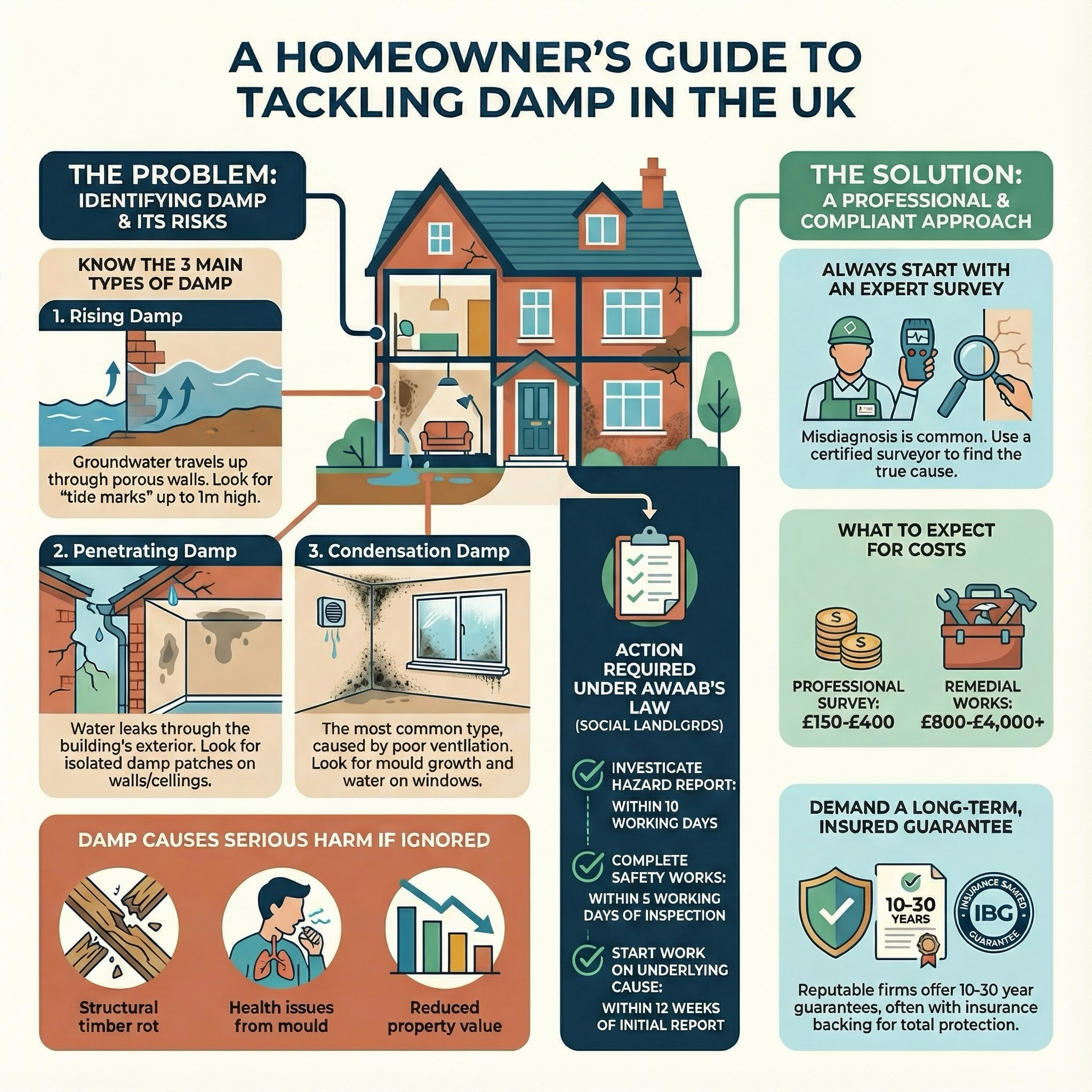
Damp Proofer explained
A damp proof course (DPC) is the horizontal layer that stops moisture rising through walls. Most UK homes built after 1875 have a slate or bitumen DPC; pre-1875 may have none. Expect to pay £400–£2,500 for UK DPC installation or remediation.
Three main scenarios. Chemical DPC injection: silicone cream injected at mortar level. Most common UK remediation. Physical DPC replacement: removing brick courses, inserting new DPC strip, rebuilding. Major work. Bridge removal: where ground level or rendered finish bridges the existing DPC, remove the bridge.
| Item | Low (£) | High (£) | Notes |
|---|---|---|---|
| Chemical DPC injection per metre | 50 | 120 | Dryzone, Aquapol |
| Physical DPC retrofit per metre | 120 | 300 | Brick course replacement |
| Bridged DPC remediation per metre | 40 | 120 | Lower external level |
| Internal plaster replacement | 50 | 120 | Per m², salt-resistant |
| Single wall complete (typical) | 800 | 2,500 | 10–15m of wall |
| Whole house chemical DPC | 2,500 | 8,500 | 4-bed terrace |
| Insurance-backed guarantee | 0 | 200 | For 20–30 year cover |
Single wall chemical DPC: 1 day plus 4–6 weeks for plaster to dry. Physical DPC retrofit: 1–2 weeks per wall. Bridge remediation: 1 day plus rendering time.
Professional. PCA-qualified contractor for chemical DPC. Structural work needs proper expertise. DIY chemical cream available but proper diagnosis essential.
PCA member. Insurance-backed guarantee (GPI, IBG). 20–30 year warranty in writing. Reputable products (Dryzone, Aquapol, Sika).
Listed buildings need consent before any DPC work. PCA Code of Practice. Building Regs Part C (moisture control).
Only if the existing DPC has failed or doesn't exist. Pre-1875 properties often have no DPC. Post-1875 should have one but may be bridged.
Chemical (injected cream): cheaper, less disruptive, 20–30 year warranty. Physical (replacement strip): more permanent but invasive. Chemical is the modern UK standard.
Modern render or paving rises above the DPC level externally. Cement render on solid walls. Modern plaster internally connecting top of DPC to wall above.
20–30 years warranty typical. Many last decades longer. Quality products (Dryzone, Aquapol) backed by independent test data.
Yes — salt-contaminated plaster up to 1m above DPC must be removed and replaced with salt-resistant render.
Allow 4–6 weeks for walls to dry, then 2–3 weeks for new plaster to dry. Total 6–9 weeks before paint.
This guide was written with AI assistance and is intended for general information only. Prices are estimates based on UK averages and may vary by region. Always get at least three quotes and consult a qualified professional before starting any work.
Ask follow-ups in plain English. The AI explains options, sequencing and what to ask the damp proofer — so you walk in informed.
Dry rot ( Serpula lacrymans ) is one of the most serious threats to UK homes. Unlike wet rot, dry rot has the unique ability to spread through masonry and plast...
READ GUIDE →GuideEmergency damp proofing is a critical intervention for UK homeowners facing sudden moisture ingress or structural failure. Left unchecked, damp can lead to timb...
READ GUIDE →GuideStructural waterproofing is the specialised process of protecting a building's foundations and below-ground spaces from groundwater ingress. For UK homeowners, ...
READ GUIDE →GuidePenetrating damp is a common headache for UK homeowners, often caused by water "soaking" through external walls into the property. Unlike rising damp, which cli...
READ GUIDE →GuideDamp is one of the most common issues facing UK homeowners, particularly given our wet climate and ageing housing stock. Whether you are buying a new property o...
READ GUIDE →GuideDamp is more than just an unsightly patch on the wall; it is a warning sign of underlying structural issues that can impact your health and your home's value. A...
READ GUIDE →