Instant
01 · Ask
Ask the AI a follow-up
Got more questions about damp Treatment Warranties & Insurance? Describe the bit you're unsure about — the AI explains options, sequencing and what to ask the damp proofer.

GPI, PCA or insurer-backed warranty — what they cover, when they pay out and how to spot a useless one.
You've read the brief on damp Treatment Warranties & Insurance. Now lean on us to find the right damp proofer — and stay in control of the job.
Got more questions about damp Treatment Warranties & Insurance? Describe the bit you're unsure about — the AI explains options, sequencing and what to ask the damp proofer.
Costs, timelines, pitfalls and the right questions to ask before any damp proofer starts on damp Treatment Warranties & Insurance.
Itemised quotes from up to 3 local damp proofers on damp Treatment Warranties & Insurance — so you can compare like-for-like, not lump sums.
Ready when you are
Enter your postcode and get free quotes from local pros.
Four moves that separate a smooth job from a nightmare.
Worthless if contractor disappears. Verify insurance-backed.
Some contractors don't include IBG in quote — adds £200–£500 later or after-the-fact.
Read terms — some IBGs transfer to new owner, others don't.
Some IBG providers charge annual maintenance fees. Should be specified upfront.
Indicative UK ranges and what affects price.
By job type
Quote spread is typically ± 18% — always get 3 quotes.
Damp Proofer quick-view
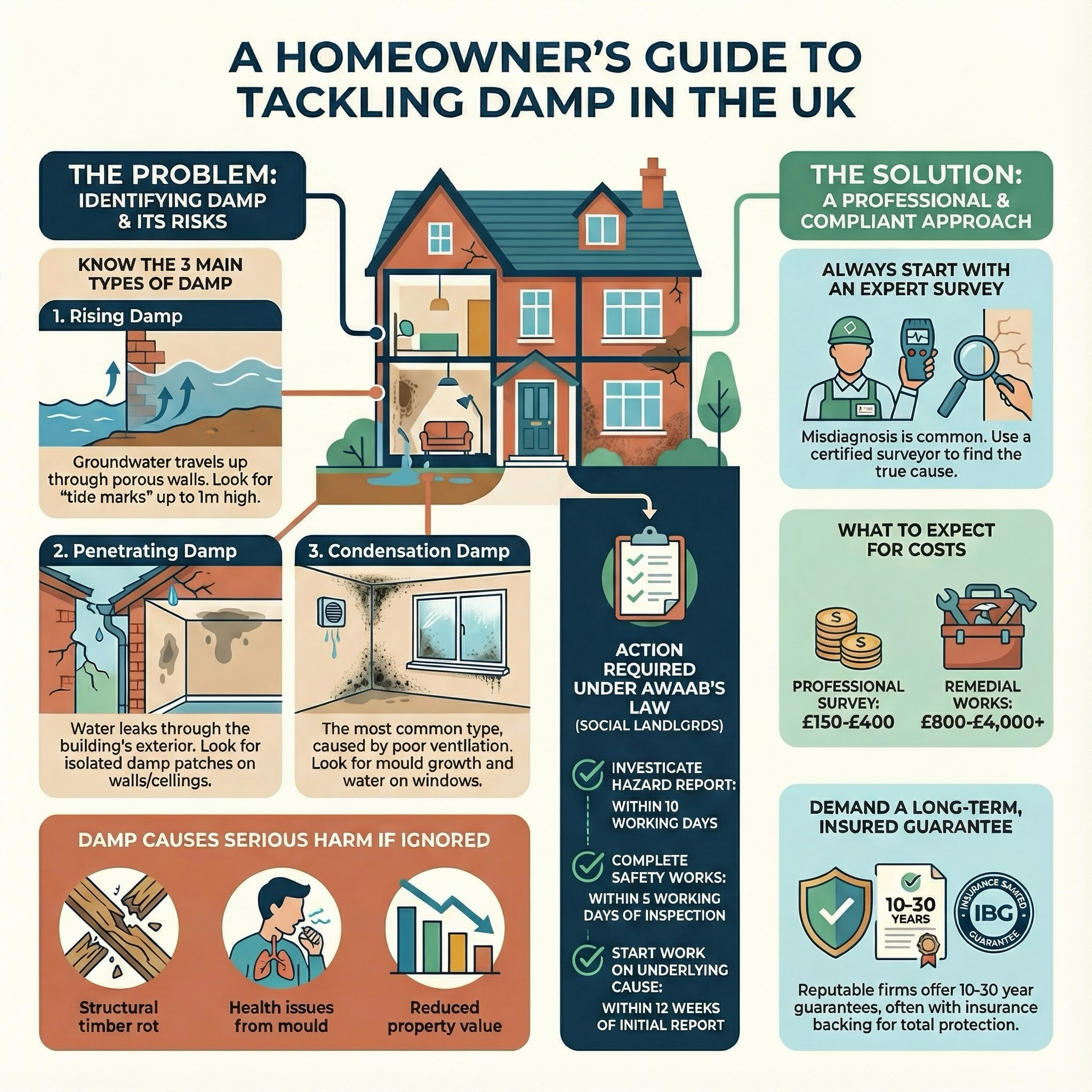
Damp Proofer explained
Damp treatment warranties protect you for 20–30 years — but only if backed by insurance. A non-insurance-backed "lifetime guarantee" is worthless if the contractor goes out of business. Expect to pay £200–£500 extra for insurance-backed guarantee (IBG) on UK damp work.
Insurance-backed guarantee (IBG): underwriter (typically GPI - Guarantee Protection Insurance) issues a policy. If the original contractor fails or refuses to honour the guarantee, the insurance pays for remedial work. Common UK providers: GPI, Quality Mark Protected, HomePro, Independent Warranty Association.
| Item | Low (£) | High (£) | Notes |
|---|---|---|---|
| Contractor guarantee (without insurance) | 0 | 0 | Worthless if contractor fails |
| GPI insurance-backed guarantee | 200 | 400 | Most popular |
| Quality Mark Protected guarantee | 180 | 350 | Government-backed scheme |
| HomePro insurance-backed | 200 | 500 | Comprehensive |
| IWA (Independent Warranty Association) | 250 | 500 | Industry scheme |
| 20-year IBG typical cost | 250 | 500 | For full damp treatment |
| 30-year IBG (premium) | 350 | 650 | Longer protection |
IBG issued at completion of work — typically 2–4 weeks after work finishes. Policy document arrives by post or PDF.
Insurance is professional only — sold by contractor or directly by underwriter. PCA member contractors typically include in quotes.
PCA member with insurance-backed guarantee. Verify the IBG provider's reputation. Quality Mark Protected and GPI are well-established UK schemes.
FCA regulates insurance products. IBG providers must be authorised. PCA Code of Practice requires insurance-backed guarantee for full membership.
Insurance policy that pays for remedial work if the original contractor fails to honour their guarantee (bankruptcy, retirement, refusing to return). Real protection vs paper-only "lifetime guarantee".
£200–£500 typical for 20-year damp treatment cover. £350–£650 for 30-year. Often bundled with quote.
Most IBGs transfer to new property owner. Confirm at purchase — read policy small print.
Damp warranties run 20–30 years. Even reliable contractors can retire, go bust, or change focus. Insurance is the only protection that outlives the contractor.
Most do. Some have it as standard; others offer as optional add-on. Confirm at quote stage.
Yes — surveyors and buyers value insurance-backed guarantees. Properly documented IBG strengthens resale. Non-IBG guarantees flagged as concerns.
This guide was written with AI assistance and is intended for general information only. Prices are estimates based on UK averages and may vary by region. Always get at least three quotes and consult a qualified professional before starting any work.
Ask follow-ups in plain English. The AI explains options, sequencing and what to ask the damp proofer — so you walk in informed.
Dry rot ( Serpula lacrymans ) is one of the most serious threats to UK homes. Unlike wet rot, dry rot has the unique ability to spread through masonry and plast...
READ GUIDE →GuideEmergency damp proofing is a critical intervention for UK homeowners facing sudden moisture ingress or structural failure. Left unchecked, damp can lead to timb...
READ GUIDE →GuideStructural waterproofing is the specialised process of protecting a building's foundations and below-ground spaces from groundwater ingress. For UK homeowners, ...
READ GUIDE →GuidePenetrating damp is a common headache for UK homeowners, often caused by water "soaking" through external walls into the property. Unlike rising damp, which cli...
READ GUIDE →GuideDamp is one of the most common issues facing UK homeowners, particularly given our wet climate and ageing housing stock. Whether you are buying a new property o...
READ GUIDE →GuideDamp is more than just an unsightly patch on the wall; it is a warning sign of underlying structural issues that can impact your health and your home's value. A...
READ GUIDE →