Instant
01 · Ask
Ask the AI a follow-up
Got more questions about flooding & Water Damage Recovery? Describe the bit you're unsure about — the AI explains options, sequencing and what to ask the damp proofer.

Dry-out, sanitise, repair and re-decorate — by insurance-approved restoration specialists.
You've read the brief on flooding & Water Damage Recovery. Now lean on us to find the right damp proofer — and stay in control of the job.
Got more questions about flooding & Water Damage Recovery? Describe the bit you're unsure about — the AI explains options, sequencing and what to ask the damp proofer.
Costs, timelines, pitfalls and the right questions to ask before any damp proofer starts on flooding & Water Damage Recovery.
Itemised quotes from up to 3 local damp proofers on flooding & Water Damage Recovery — so you can compare like-for-like, not lump sums.
Ready when you are
Enter your postcode and get free quotes from local pros.
Four moves that separate a smooth job from a nightmare.
Plastering before walls fully dry causes recurring damp. Insist on documented moisture readings before re-plaster.
Sockets that submerged need PIR (Periodic Inspection Report) — many homes had unsafe electrics post-flood.
Sewage-contaminated water needs additional sanitisation. Don't skimp.
Wet insulation never properly dries — replace it.
Indicative UK ranges and what affects price.
By job type
Quote spread is typically ± 18% — always get 3 quotes.
Damp Proofer quick-view
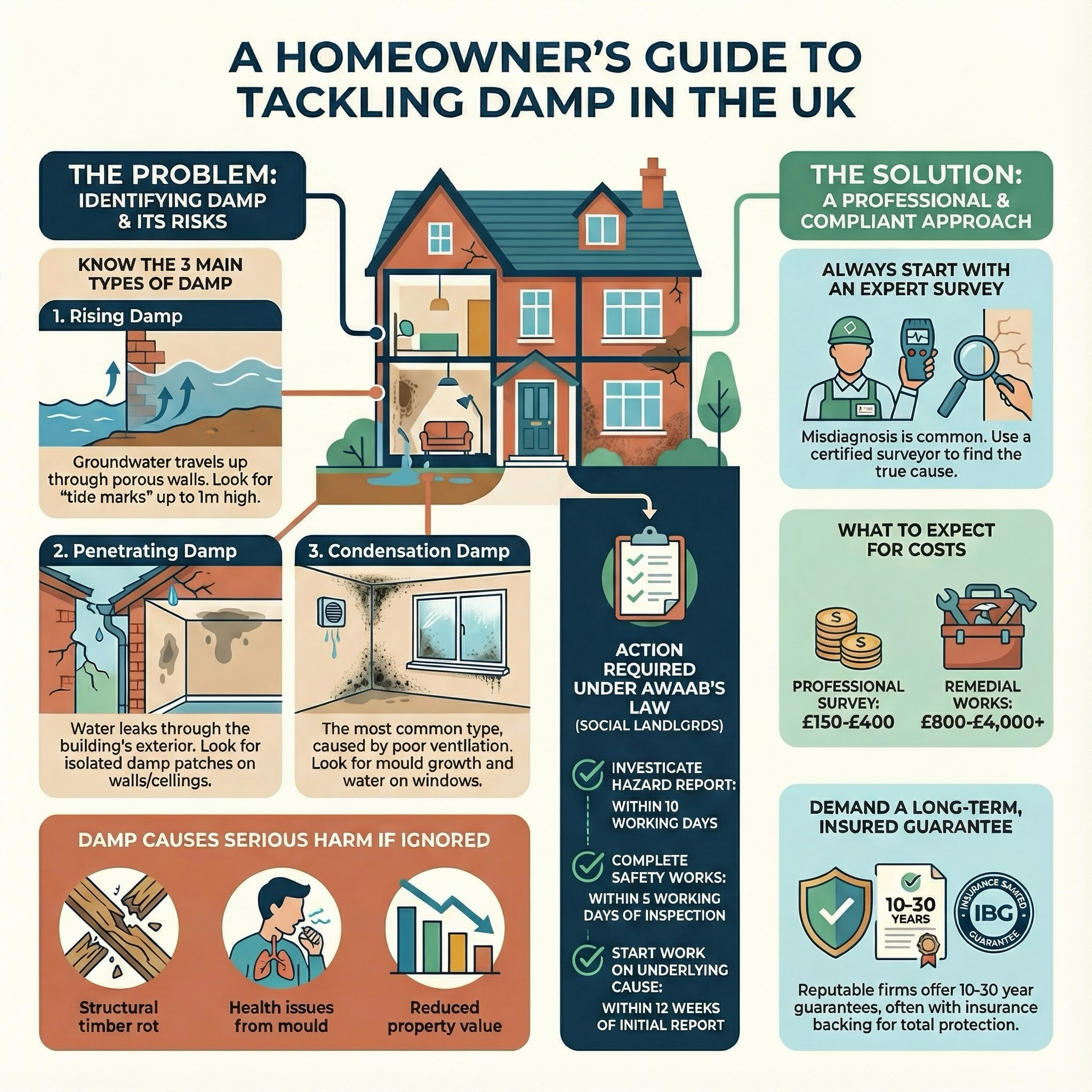
Damp Proofer explained
Recovering from flooding involves drying, sanitisation, electrical inspection, and full re-instatement. Insurance often covers most costs. Expect to pay £3,500–£40,000+ for UK flood recovery depending on flood height and house size.
Phase 1: Emergency response — water extraction, dehumidifiers, structural drying. Phase 2: Strip out — water-damaged plaster, insulation, flooring, kitchens, fitted furniture. Phase 3: Drying period — 4–12 weeks with industrial drying equipment. Phase 4: Sanitisation against contamination. Phase 5: Re-instatement — replaster, redecorate, replace flooring, kitchen, electrical inspection (often re-wire if water reached sockets).
| Item | Low (£) | High (£) | Notes |
|---|---|---|---|
| Water extraction emergency | 500 | 2,500 | First 24 hours |
| Industrial drying 4–8 weeks | 1,500 | 5,000 | Dehumidifiers, heaters |
| Strip out water-damaged materials | 1,500 | 5,000 | Plaster, insulation, floor |
| Electrical inspection + repair | 500 | 3,500 | Re-wire if water reached sockets |
| Replastering ground floor | 2,000 | 6,000 | 1m height affected walls |
| Replace ground floor flooring | 1,500 | 8,000 | Depending on type |
| Replace kitchen if affected | 4,000 | 15,000 | If floor-mounted units |
| Full ground floor flood recovery | 15,000 | 40,000+ | Depends on flood height |
Emergency response: 24–48 hours. Drying: 4–12 weeks. Full recovery and reinstatement: 4–9 months. Severe floods: longer.
Professional. Insurance typically requires accredited damage recovery company. CILA (Chartered Institute of Loss Adjusters) experience helpful.
BDMA (British Damage Management Association) member. Insurance company-approved contractor (often nominated). Major brands: Munters, ServiceMaster, Belfor, Polygon. Independent damp surveyor (PCA) to validate drying.
No specific Building Regs for water damage recovery. Building Regs Part L may apply if insulation replaced. Electrical Part P for any rewire work.
Buildings and contents insurance with flood cover: yes. Some policies exclude flood. Check before incident — Flood Re scheme makes flood cover available.
Drying alone: 4–12 weeks. Full recovery: 4–9 months. Severe damage: longer.
Initial water extraction yes, but industrial drying requires specialist equipment (dehumidifiers, heaters, monitoring). Insurance typically pays for it.
Costs come from your pocket. Some council/government emergency funds available. Apply early — funds dwindle quickly post-disaster.
Quality recovery: yes — fully restored. Cheap quotes that don't dry properly: recurring damp problems for years.
Flood barriers (Floodwall, Floodgate UK), waterproof gates, raised sockets, sump pump, tanked floors. Property Flood Resilience grants may be available.
This guide was written with AI assistance and is intended for general information only. Prices are estimates based on UK averages and may vary by region. Always get at least three quotes and consult a qualified professional before starting any work.
Ask follow-ups in plain English. The AI explains options, sequencing and what to ask the damp proofer — so you walk in informed.
Dry rot ( Serpula lacrymans ) is one of the most serious threats to UK homes. Unlike wet rot, dry rot has the unique ability to spread through masonry and plast...
READ GUIDE →GuideEmergency damp proofing is a critical intervention for UK homeowners facing sudden moisture ingress or structural failure. Left unchecked, damp can lead to timb...
READ GUIDE →GuideStructural waterproofing is the specialised process of protecting a building's foundations and below-ground spaces from groundwater ingress. For UK homeowners, ...
READ GUIDE →GuidePenetrating damp is a common headache for UK homeowners, often caused by water "soaking" through external walls into the property. Unlike rising damp, which cli...
READ GUIDE →GuideDamp is one of the most common issues facing UK homeowners, particularly given our wet climate and ageing housing stock. Whether you are buying a new property o...
READ GUIDE →GuideDamp is more than just an unsightly patch on the wall; it is a warning sign of underlying structural issues that can impact your health and your home's value. A...
READ GUIDE →