Instant
01 · Ask
Ask the AI a follow-up
Got more questions about internal Wall Insulation for Damp? Describe the bit you're unsure about — the AI explains options, sequencing and what to ask the damp proofer.

For damp solid walls — IWI with vapour control, breathable systems, or insulated plasterboard.
You've read the brief on internal Wall Insulation for Damp. Now lean on us to find the right damp proofer — and stay in control of the job.
Got more questions about internal Wall Insulation for Damp? Describe the bit you're unsure about — the AI explains options, sequencing and what to ask the damp proofer.
Costs, timelines, pitfalls and the right questions to ask before any damp proofer starts on internal Wall Insulation for Damp.
Itemised quotes from up to 3 local damp proofers on internal Wall Insulation for Damp — so you can compare like-for-like, not lump sums.
Ready when you are
Enter your postcode and get free quotes from local pros.
Four moves that separate a smooth job from a nightmare.
Vapour from inside the home condenses on cold brick behind insulation, soaking the wall. Cause of many IWI failures.
Where insulation stops at floor, ceiling, window — heat escapes and condensation forms. Continuous insulation essential.
Wall can't breathe outward (cement) or inward (insulation). Solid-wall buildings need breathable solution.
IWI eats 80–150mm of room. Worth calculating before committing.
Indicative UK ranges and what affects price.
By job type
Quote spread is typically ± 18% — always get 3 quotes.
Damp Proofer quick-view
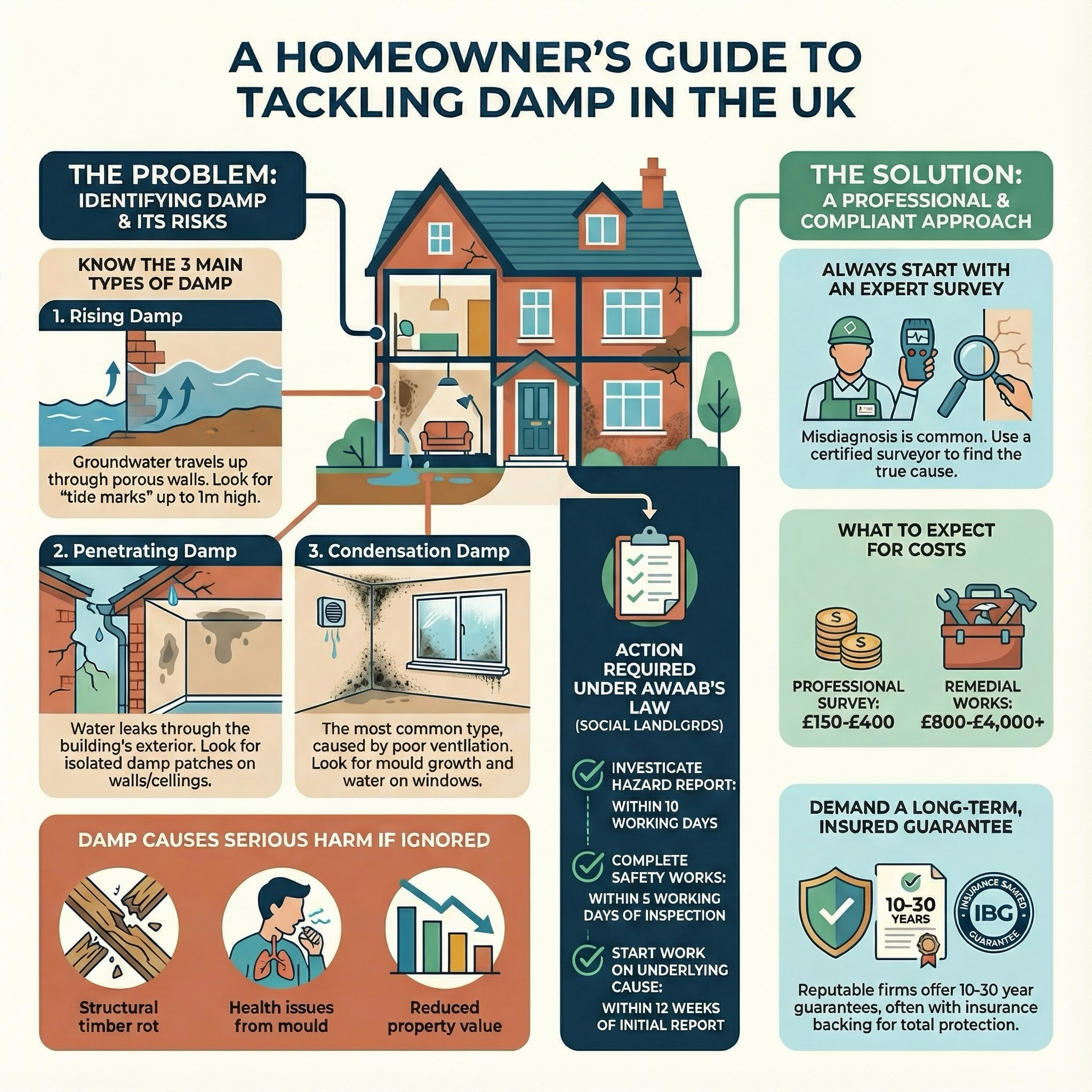
Damp Proofer explained
Internal wall insulation (IWI) cuts heat loss through solid walls — common in pre-1919 UK homes. But poorly specified IWI can trap damp behind it. Expect to pay £40–£120 per m² in the UK for solid wall internal insulation.
Existing wall stripped to brick or original plaster. Vapour control layer applied (or breathable system used). Insulation layer: PIR boards (Celotex, Kingspan, 50–100mm thick), insulated plasterboard (Knauf XPS), or breathable wood fibre (Steico) for heritage. Plasterboard or skim finish. Critical: cold bridging at floor, ceiling, window reveals must be designed out.
| Item | Low (£) | High (£) | Notes |
|---|---|---|---|
| PIR insulation board per m² | 20 | 40 | Celotex, Kingspan, EcoTherm |
| Insulated plasterboard per m² | 25 | 50 | Knauf XPS, British Gypsum |
| Wood fibre breathable per m² | 40 | 90 | Steico, Pavadry, Diffutherm |
| Vapour control layer per m² | 5 | 15 | Plastic VCL or breathable |
| Install labour per m² | 20 | 50 | Plus material |
| Single wall (20 m²) PIR system | 700 | 1,500 | Including labour |
| Single wall heritage wood fibre | 1,500 | 3,500 | Premium specification |
| Whole house IWI (Victorian terrace) | 8,000 | 20,000 | All external walls |
Single wall (20 m²): 3–5 days including plastering and decoration. Whole house: 4–8 weeks.
Professional. Vapour barrier detail, cold-bridge management, and breathability all need experienced contractor. Cheap install causes damp problems.
PCA insulation specialist or qualified plasterer/builder. SPAB-accredited for heritage homes. Confirm breathable strategy if solid-wall pre-1919. Get warranty in writing.
Building Regs Part L thermal compliance for retrofitted walls. Listed buildings need consent. Ofgem ECO grants may cover for qualifying households.
Poorly specified, yes. Properly specified with appropriate vapour barriers or breathable systems, no. Solid-wall homes especially need breathable IWI.
PIR (Celotex, Kingspan): higher R-value per mm, cheaper, requires vapour barrier. Wood fibre (Steico): breathable, suits solid walls, more expensive. Modern UK heritage practice uses wood fibre.
25–40% reduction in heat loss through external walls. Combined with other upgrades (loft, windows): can halve heating bills.
External (EWI): more expensive (£80–£150/m²), no loss of floor area, doesn't change interior. Internal (IWI): cheaper, easier per-room phased upgrade. EWI is the cleaner long-term solution where possible.
Quality work increases value through energy efficiency. Poor work that causes damp decreases value significantly.
ECO4 and GBIS for qualifying households (means-tested or low EPC rating). Some local authorities have their own grants. Check via energy supplier.
This guide was written with AI assistance and is intended for general information only. Prices are estimates based on UK averages and may vary by region. Always get at least three quotes and consult a qualified professional before starting any work.
Ask follow-ups in plain English. The AI explains options, sequencing and what to ask the damp proofer — so you walk in informed.
Dry rot ( Serpula lacrymans ) is one of the most serious threats to UK homes. Unlike wet rot, dry rot has the unique ability to spread through masonry and plast...
READ GUIDE →GuideEmergency damp proofing is a critical intervention for UK homeowners facing sudden moisture ingress or structural failure. Left unchecked, damp can lead to timb...
READ GUIDE →GuideStructural waterproofing is the specialised process of protecting a building's foundations and below-ground spaces from groundwater ingress. For UK homeowners, ...
READ GUIDE →GuidePenetrating damp is a common headache for UK homeowners, often caused by water "soaking" through external walls into the property. Unlike rising damp, which cli...
READ GUIDE →GuideDamp is one of the most common issues facing UK homeowners, particularly given our wet climate and ageing housing stock. Whether you are buying a new property o...
READ GUIDE →GuideDamp is more than just an unsightly patch on the wall; it is a warning sign of underlying structural issues that can impact your health and your home's value. A...
READ GUIDE →