Instant
01 · Ask
Ask the AI a follow-up
Got more questions about loft Conversion Planning Permission? Describe the bit you're unsure about — the AI explains options, sequencing and what to ask the loft conversions.

Most loft conversions are permitted development — but conservation areas, listings and major dormers may need planning.
You've read the brief on loft Conversion Planning Permission. Now lean on us to find the right loft conversions — and stay in control of the job.
Got more questions about loft Conversion Planning Permission? Describe the bit you're unsure about — the AI explains options, sequencing and what to ask the loft conversions.
Costs, timelines, pitfalls and the right questions to ask before any loft conversions starts on loft Conversion Planning Permission.
Itemised quotes from up to 3 local loft conversionss on loft Conversion Planning Permission — so you can compare like-for-like, not lump sums.
Ready when you are
Enter your postcode and get free quotes from local pros.
Four moves that separate a smooth job from a nightmare.
Many homeowners assume permitted means no application. Lawful Development Certificate recommended.
Some conservation areas have permitted development rights removed. Always check.
New tiles different from old. Use matching tiles and stone for new dormer.
50m³ limit easy to exceed with full mansard. Calculate carefully.
Indicative UK ranges and a typical week-by-week schedule.
By job type
Quote spread is typically ± 18% — always get 3 quotes.
Dormer loft conversion · week by week
Schedule slips on dependencies — pad each phase by 10–20% for real-world delays.
Loft Conversions quick-view
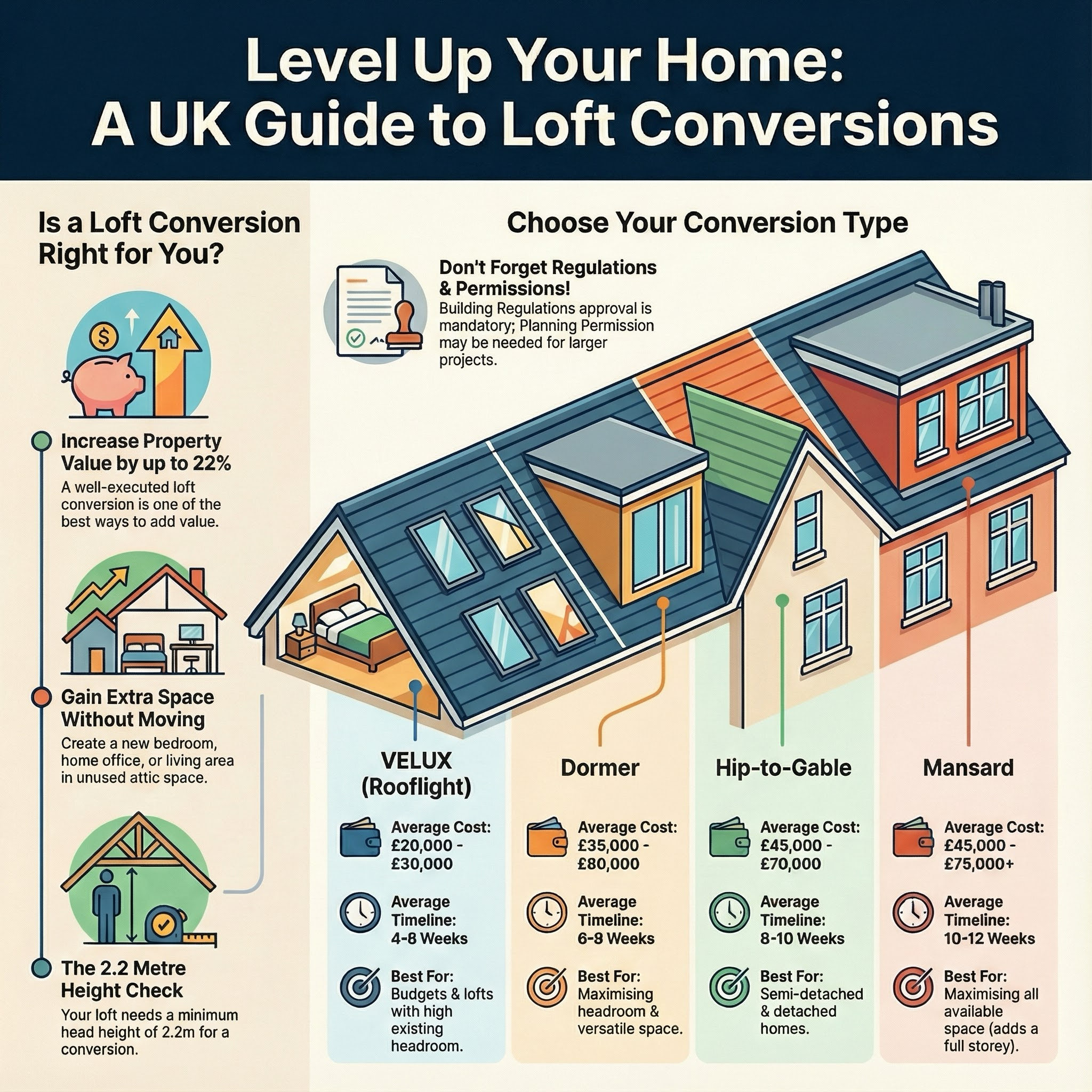
Loft Conversions explained
Most UK loft conversions are permitted development — but rear dormers and mansards often need planning. Understanding the rules saves time and money. Lawful Development Certificate (£103) confirms permitted development.
Designer or homeowner checks Permitted Development rules. Maximum 50m³ additional volume for terraces; 40m³ for semi/detached. Dormers must be set back 200mm from eaves. Materials must match existing roof. Front dormer almost always needs planning. Conservation areas have stricter rules.
| Item | Low (£) | High (£) | Notes |
|---|---|---|---|
| Lawful Development Certificate | 103 | 103 | Fixed council fee |
| Planning application (householder) | 206 | 206 | Fixed national fee |
| Pre-application advice | 50 | 250 | Council planning officer |
| Architect planning drawings | 500 | 2,500 | For application |
| Planning consultant | 500 | 2,500 | For complex cases |
| Listed building consent | 0 | 0 | Free but mandatory |
| Heritage consultant | 500 | 3,500 | For listed buildings |
Lawful Development Certificate: 8 weeks. Planning permission: 8 weeks (extended for major). Listed building consent: 8 weeks.
Architect for plans and submission. Planning consultant for complex cases.
Architect with conversion experience. Loft conversion specialist often handles application as part of service.
Permitted Development Order 2015: rear dormer up to 50m³ (40m³ for semi/detached). Front-facing roof additions need planning. Conservation areas often stricter. Listed buildings need consent.
Rear dormer within 50m³: usually permitted. Front-facing roof addition: usually planning required. Conservation areas: usually planning. Listed: always consent.
A council-issued document confirming your build is permitted development. £103, 8 weeks. Highly recommended even when confident — protects property at resale.
Rear dormer max 50m³ (40m³ for semi/detached). Must be set back 200mm from eaves. No higher than ridge. Match existing materials.
Yes — to the Planning Inspectorate. 6 months from refusal. Specialist consultant recommended.
Always needs consent. Many listed buildings reject conversion. Heritage consultant essential.
Stricter than permitted development. Article 4 may remove most rights. Always check with council.
This guide was written with AI assistance and is intended for general information only. Prices are estimates based on UK averages and may vary by region. Always get at least three quotes and consult a qualified professional before starting any work.
Ask follow-ups in plain English. The AI explains options, sequencing and what to ask the loft conversions — so you walk in informed.
Installing a loft ladder is one of the most cost-effective ways to unlock hidden storage space in your UK home. Beyond convenience, a professionally fitted ladd...
READ GUIDE →GuideMaintaining the floor boarding in your loft is essential for both safe storage and the structural integrity of your home. Over time, older chipboard can bow, cr...
READ GUIDE →GuideBoarding out your loft is one of the most cost-effective ways to increase your home's storage capacity without the expense of a full conversion. In the UK, wher...
READ GUIDE →GuideInstalling a professional loft ladder is one of the most cost-effective ways to add value and functionality to your UK home. Rather than struggling with a preca...
READ GUIDE →GuideConverting a dusty attic into functional storage is one of the most cost-effective ways to add value and space to a UK home. By utilising the "dead space" above...
READ GUIDE →GuideA faulty loft hatch is more than just a minor inconvenience; it is a primary source of heat loss and a potential safety hazard. In the UK, where energy efficien...
READ GUIDE →