Instant
01 · Ask
Rooflight, dormer or mansard?
Roof shape and headroom dictate options. Describe the loft and the AI tells you which conversion type fits.

Dormer, hip-to-gable, Velux or full conversion — quoted from sketch or architect drawings.
Read the brief on headroom, fire doors and Party Wall — then let Three local loft specialists quote.
Roof shape and headroom dictate options. Describe the loft and the AI tells you which conversion type fits.
Building Regs Part B/K, Party Wall Awards, structural calcs, planning vs permitted development. Know the rules.
Three local specialists quote on the same drawing — structural, fit-out, en suite — so you compare like-for-like.
Ready when you are
Enter your postcode and get free quotes from local pros.
Four moves that separate a smooth job from a nightmare.
Building Regs need 2.0m clear above stairs and over 50% of floor area. Survey headroom first — anything less and you're in dormer or roof-lift territory.
Loft conversions need 30-minute fire-rated doors on every room off the stair from the ground floor up. Cheap doors fail Building Control.
Steel beams or padstones on existing walls need calcs. Pay £400–£800 for an SE — saves £5,000 in retrofit reinforcement.
Terraced or semi-detached needs a Party Wall Award before steel goes in. Skip this and your neighbour can stop the job.
Indicative UK ranges and a typical week-by-week schedule.
By job type
Quote spread is typically ± 18% — always get 3 quotes.
Dormer loft conversion · week by week
Schedule slips on dependencies — pad each phase by 10–20% for real-world delays.
Visual breakdown of costs, timelines and the questions you should be asking.
Loft Conversions quick-view
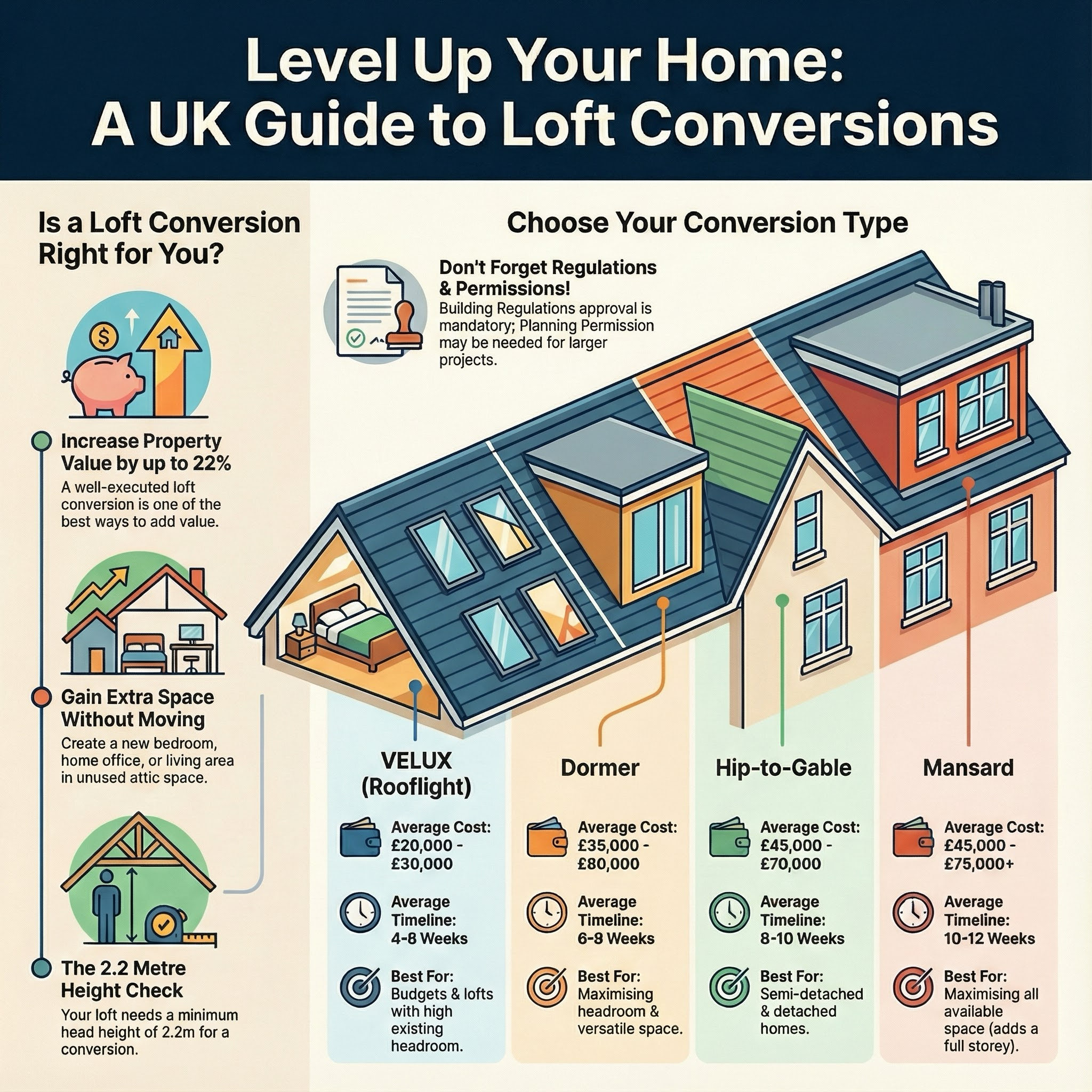
Loft Conversions explained
Everything you need to know before hiring a loft conversions.
A loft conversion is one of the most effective ways to increase your home’s square footage and market value without sacrificing garden space. By transforming an underutilised attic into a functional living area, you can create a master suite, a quiet home office, or an extra bedroom for a growing family.
Specialist loft conversion companies manage complex structural changes, from installing steel support beams to reconfiguring rooflines. They coordinate various trades, including carpenters, roofers, electricians, and plumbers, to ensure the new space is safe, insulated, and fully integrated with the rest of your home.
Whether you are looking for a simple rooflight conversion or a substantial mansard extension, hiring a dedicated specialist ensures the project meets strict UK Building Regulations. They navigate the technical challenges of head height, staircase placement, and fire safety to deliver a seamless addition to your property.
Loft conversions are major structural undertakings that should never be attempted as a DIY project. Professional installers understand the critical nature of load-bearing walls and the necessity of structural steel to prevent your roof from sagging or collapsing.
Compliance with UK Building Regulations is mandatory for any loft conversion. A professional ensures your project meets Part L (thermal efficiency), Part K (staircase safety), and Part B (fire safety), which includes installing fire-rated doors and mains-linked smoke alarms. Without a completion certificate from Building Control, you will struggle to sell your home in the future.
Specialists also carry the necessary Public Liability and Professional Indemnity insurance. This protects you against accidental damage to your property during the build and provides recourse if structural issues arise after the work is completed.
| Service | Low £ | High £ | Notes |
|---|---|---|---|
| Velux (Rooflight) Conversion | £25,000 | £40,000 | No change to roofline; requires 2.2m head height. |
| Dormer Loft Conversion | £45,000 | £65,000 | Adds significant floor space and head height. |
| Hip-to-Gable Conversion | £55,000 | £75,000 | Common for semi-detached/end-of-terrace homes. |
| Mansard Loft Conversion | £65,000 | £90,000+ | Major aesthetic change; usually requires planning. |
| Architectural Plans & Calcs | £1,500 | £3,500 | Essential for building regs and structural safety. |
Prices vary significantly based on your location in the UK, the age of your property, and the level of internal finish. Adding an ensuite bathroom typically adds £5,000 to £8,000 to the total cost due to plumbing and tiling requirements.
Questions to ask before hiring:
In many cases, loft conversions fall under Permitted Development (PD), meaning you don't need full planning permission. However, specific limits apply to the volume of added space, and PD rights do not apply in Conservation Areas or to listed buildings.
According to Nationwide Building Society, a well-executed loft conversion that adds a bedroom and an ensuite can increase a property's value by up to 20%. It is widely considered one of the best home improvements for Return on Investment (ROI).
A simple Velux conversion can take 4 to 6 weeks. More complex dormer or hip-to-gable conversions typically take 8 to 12 weeks, depending on weather conditions and the complexity of the internal fit-out.
For a loft to be legally habitable, you generally need a finished head height of 2.2 metres at the highest point. If your current attic is lower, you may need to lower the ceilings of the rooms below, which significantly increases costs.
Describe the job in plain English. The AI asks a few smart questions, then tells you whether a loft conversions is the right call, what it should cost, and what to ask before they start.
Converting a bungalow loft adds an entire floor. UK costs and considerations.
READ GUIDE →GuideDormer loft conversions maximise space and headroom. UK costs, types and planning.
READ GUIDE →GuideHip-to-gable converts sloped roof corner to gable end for more space. UK costs and end-terrace homes.
READ GUIDE →GuideConverting a loft in a listed building. UK costs and consent requirements.
READ GUIDE →GuideLoft conversions need full Building Regs notification. UK guide to what's covered.
READ GUIDE →GuideAdding an en-suite to a loft conversion. UK costs and plumbing routing.
READ GUIDE →GuideLighting design for loft conversions. UK costs and where to plan lighting.
READ GUIDE →GuideWhen loft conversions need planning permission. UK guide to permitted development.
READ GUIDE →GuideReturn on investment for UK loft conversions. Payback calculations and value impact.
READ GUIDE →GuideLoft conversion stairs must comply with Part K. UK costs and design options.
READ GUIDE →GuideMaximising loft storage in conversions. UK costs for fitted wardrobes and clever solutions.
READ GUIDE →GuideVentilation in loft conversions. UK costs for trickle vents, MVHR and bathroom extractors.
READ GUIDE →GuideWindow options for loft conversion. UK costs for Velux roof windows and dormer windows.
READ GUIDE →GuideLoft conversion or single-storey extension. UK costs and which gives better value.
READ GUIDE →GuideA loft conversion adds 15-25% to property value. UK costs by type and what's involved.
READ GUIDE →GuideWhat loft conversions really cost in the UK in 2026. Complete pricing reference.
READ GUIDE →GuideLoft insulation cuts heating bills 25%. UK costs and grant eligibility.
READ GUIDE →GuideMansard conversions maximise loft space with two pitches. UK costs and where they suit.
READ GUIDE →GuideVelux conversions are the cheapest loft option. UK costs and where they work.
READ GUIDE →A sturdy loft ladder is the gatekeeper to your home’s extra storage or attic living space. While these ladders are built for durability, years of use can lead t...
READ GUIDE →GuideInstalling a loft ladder is one of the most cost-effective ways to unlock hidden storage space in your UK home. Beyond convenience, a professionally fitted ladd...
READ GUIDE →GuideInstalling a professional loft ladder is one of the most cost-effective ways to add value and functionality to your UK home. Rather than struggling with a preca...
READ GUIDE →GuideInstalling a loft ladder is one of the most cost-effective ways to reclaim wasted space in a UK home. Beyond providing safe and easy access to storage, a profes...
READ GUIDE →Boarding out your loft is one of the most cost-effective ways to increase your home's storage capacity without the expense of a full conversion. In the UK, wher...
READ GUIDE →GuideLoft floor needs strengthening before habitable use. UK costs and methods.
READ GUIDE →GuideMaintaining the floor boarding in your loft is essential for both safe storage and the structural integrity of your home. Over time, older chipboard can bow, cr...
READ GUIDE →