Instant
01 · Ask
Ask the AI a follow-up
Got more questions about indian Sandstone Patio — Cost, Install & UK? Describe the bit you're unsure about — the AI explains options, sequencing and what to ask the patios.

Most popular UK natural-stone patio — Indian sandstone in pink, grey or buff. Riven or sawn finish.
You've read the brief on indian Sandstone Patio — Cost, Install & UK. Now lean on us to find the right patios — and stay in control of the job.
Got more questions about indian Sandstone Patio — Cost, Install & UK? Describe the bit you're unsure about — the AI explains options, sequencing and what to ask the patios.
Costs, timelines, pitfalls and the right questions to ask before any patios starts on indian Sandstone Patio — Cost, Install & UK.
Itemised quotes from up to 3 local patioss on indian Sandstone Patio — Cost, Install & UK — so you can compare like-for-like, not lump sums.
Ready when you are
Enter your postcode and get free quotes from local pros.
Four moves that separate a smooth job from a nightmare.
(white salt staining) — common in the first 6 months, normally clears with rain or a specialist cleaner.
— almost always a sign of spot-bedding rather than full mortar.
— happens when cheap jointing compound is used or sub-base wasn't compacted properly.
(orange spots) — natural mineral content, hard to remove. Buy from a reputable supplier who hand-picks slabs.
Indicative UK ranges and a typical week-by-week schedule.
By job type
Quote spread is typically ± 18% — always get 3 quotes.
30 m² patio install · week by week
Schedule slips on dependencies — pad each phase by 10–20% for real-world delays.
Patios quick-view
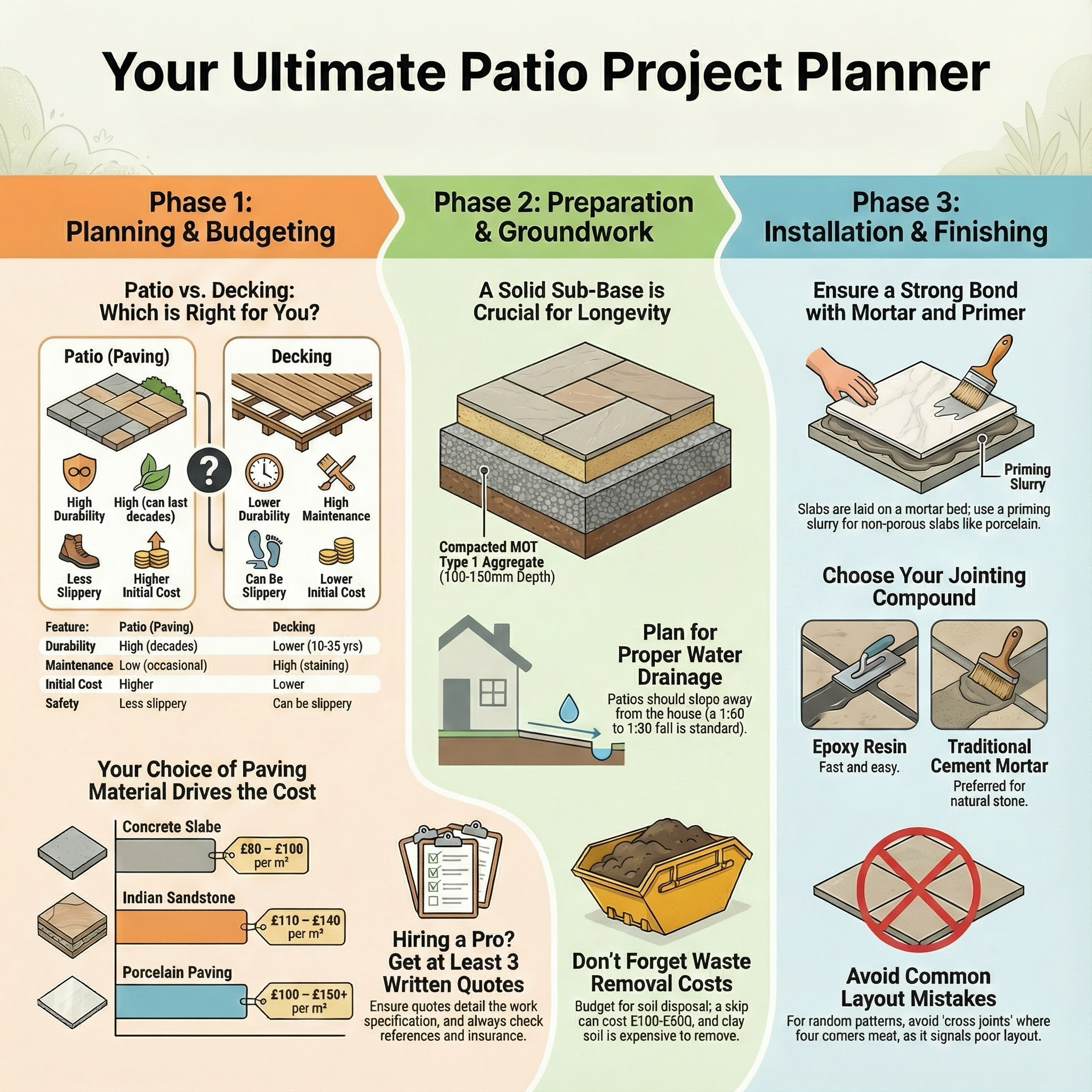
Patios explained
Indian sandstone is by far the most popular natural-stone patio material in UK gardens, and for good reason — warm tones, generous slab sizes, and a price point most homeowners can stretch to. This guide covers what a finished installation actually costs in 2026, what good prep looks like, and the small details that separate a patio that lasts twenty years from one that's loose and stained inside three.
If you're weighing it up against porcelain or limestone, read the comparison sections too. Sandstone has trade-offs — chiefly its porosity — and going in eyes-open is the difference between a patio you love and one you regret.
| Item | Low £ | High £ | Notes |
|---|---|---|---|
| 22 mm calibrated sandstone (per m²) | 30 | 55 | Mint, Raj green, Autumn brown most common |
| Sub-base, mortar & jointing materials | 18 | 30 | Per m², MOT Type 1 + cement |
| Labour (per m²) | 40 | 70 | Higher in London & SE England |
| Excavation & spoil removal | 200 | 600 | Depending on depth and skip size |
| Total installed (20 m² patio) | 1,800 | 3,200 | Excluding tricky access or steps |
| Sealing service | 120 | 300 | One-off, repeat every 2–3 years |
Access, edging detail, levels, and slab thickness drive most of the variation. A flat back-garden install with rear-vehicle access can sit at the low end; a sloped front garden with steps and through-house carrying will push you to the top.
A confident DIYer with strong help can lay a small, flat sandstone patio — the materials and methods are well-documented. But sandstone is unforgiving: slabs are heavy, the full mortar bed is fussy to get level, and the falls are often the part DIYers get wrong (leading to standing water and frost damage). For anything over 12 m², or any patio with steps, a professional usually saves money long-term.
It's optional but recommended in the UK climate. Sealing reduces staining (especially from BBQ grease and red wine) and slows algae growth. Plan to reseal every 2–3 years.
22 mm calibrated is the UK standard for residential patios. 30 mm or "uncalibrated" stock is older and varies in thickness, which makes laying much harder.
Some Indian sandstone is quarried with poor labour standards. Look for suppliers signed up to the Ethical Trading Initiative (ETI) or the Stone Federation's responsible sourcing scheme.
Yes, provided the concrete is level, in good condition, and has falls in the right direction. You'd bond the slabs with a thin-bed flexible adhesive rather than a full mortar bed.
Properly installed and lightly maintained, 25–40 years is realistic. Most failures are install-related, not the stone itself.
Slightly — UV and weather will mellow the warmer tones over the first 2–3 years, then it stabilises. Sealing preserves more of the original colour.
This guide was written with AI assistance and is intended for general information only. Prices are estimates based on UK averages and may vary by region. Always get at least three quotes and consult a qualified professional before starting any work.
Ask follow-ups in plain English. The AI explains options, sequencing and what to ask the patios — so you walk in informed.
A well-installed patio is one of the most effective ways to add value and functional living space to a UK home. Given our unpredictable climate, a durable, leve...
READ GUIDE →GuideA professionally installed patio is more than just a place for a summer BBQ; it is a functional extension of your home that can significantly increase property ...
READ GUIDE →GuideA well-designed patio is more than just a flat surface for a garden table; it is an extension of your home’s living space. In the UK, professional patio design ...
READ GUIDE →GuidePatio and Garden Maintenance Overview Refreshes patio surfaces, restores tidy garden hard‑landscapes and gets sliding/French doors running smoothly. Skill level...
READ GUIDE →GuideResin bonding is an increasingly popular choice for UK homeowners looking to revitalise tired concrete or tarmac patios without the upheaval of a full excavatio...
READ GUIDE →GuideYorkshire stone patios: reclaimed vs new, costs per m², install detail, and how to find authentic British flagstones in 2026.
READ GUIDE →