Instant
01 · Ask
Ask the AI a follow-up
Got more questions about cobblestone Patio — Cost, Traditional Style & Install? Describe the bit you're unsure about — the AI explains options, sequencing and what to ask the patios.

Traditional granite or sandstone cobbles — hand-laid, jointed and sealed for centuries-style finish.
You've read the brief on cobblestone Patio — Cost, Traditional Style & Install. Now lean on us to find the right patios — and stay in control of the job.
Got more questions about cobblestone Patio — Cost, Traditional Style & Install? Describe the bit you're unsure about — the AI explains options, sequencing and what to ask the patios.
Costs, timelines, pitfalls and the right questions to ask before any patios starts on cobblestone Patio — Cost, Traditional Style & Install.
Itemised quotes from up to 3 local patioss on cobblestone Patio — Cost, Traditional Style & Install — so you can compare like-for-like, not lump sums.
Ready when you are
Enter your postcode and get free quotes from local pros.
Four moves that separate a smooth job from a nightmare.
— recurring with kiln-dried sand. Top up annually or switch to resin joint compound.
— missing or weak edge restraint.
— sub-base wasn't compacted properly. Hard to fix without lifting.
— sand joints are open. Polymeric sand or resin joints solve it.
Indicative UK ranges and a typical week-by-week schedule.
By job type
Quote spread is typically ± 18% — always get 3 quotes.
30 m² patio install · week by week
Schedule slips on dependencies — pad each phase by 10–20% for real-world delays.
Patios quick-view
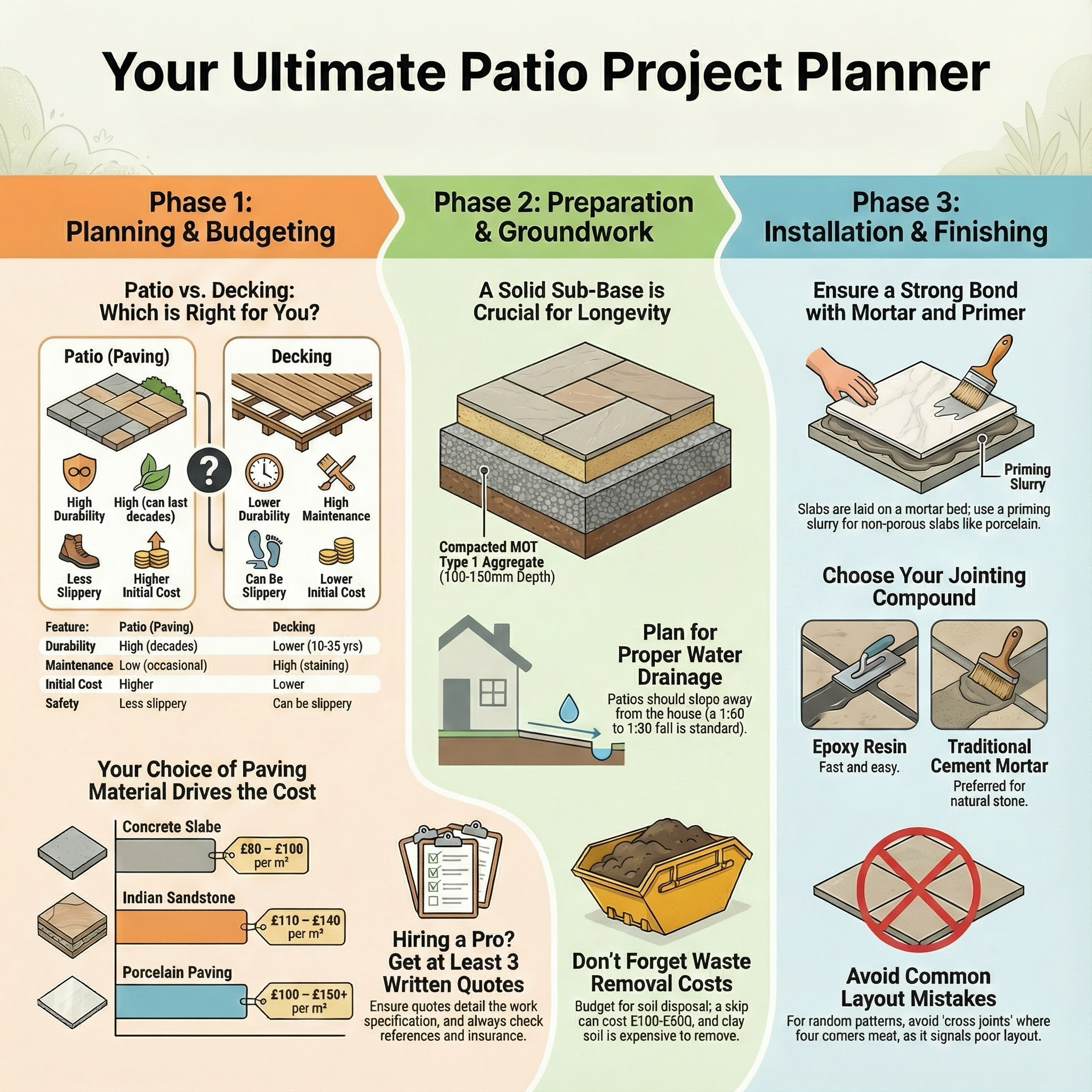
Patios explained
Cobblestone (or "sett") patios give an instantly heritage, period feel to UK gardens — perfect for Georgian, Victorian, or cottage properties. The look isn't strictly slabs, it's small cube-shaped pieces of granite (or occasionally limestone) laid in patterns. The trade-off: it's slower to lay than slabs, so labour costs are higher, but the result is unbeatably distinctive. This guide covers what cobble patios actually cost installed in 2026, the patterns to consider, and the install detail that matters.
"Cobble" technically meant rounded river stones; the cube-shaped product almost everyone now uses is a "sett" — but the language has blurred and "cobble" is widely used for both.
| Item | Low £ | High £ | Notes |
|---|---|---|---|
| 50 mm granite setts (per m²) | 40 | 80 | Grey, silver, black |
| Reclaimed Yorkshire setts (per m²) | 80 | 180 | Authentic, very limited supply |
| Sub-base & bedding (per m²) | 22 | 35 | Heavier for vehicle areas |
| Labour (per m²) | 70 | 130 | Slow work — high labour content |
| Granite sett install (20 m²) | 2,600 | 4,800 | Standard back garden |
| Reclaimed sett install (20 m²) | 4,000 | 7,200 | Heritage premium |
The pattern is a major cost driver. Herringbone and fan patterns take significantly longer than running bond. Discuss the layout in advance and get the pattern specified in the quote.
This is honest, hands-on heritage work. A patient DIYer can lay setts on a small section, but pattern alignment is harder than it looks — once a row drifts a few mm out of true it amplifies. Professional setters use string lines, bench marks, and constant adjustment. For anything over 10 m² hire a specialist.
Strictly no — cobbles are rounded river stones, setts are cut cubes. In practice the words are used interchangeably and most UK suppliers sell "cobbles" that are actually setts.
Fan and circular patterns suit period properties; running bond suits modern; herringbone is the classic all-rounder. View examples in person before deciding.
Yes — they're stronger than slabs and traditionally used for stable yards. Spec a concrete bed and 80–100 mm thick setts for vehicle loads.
Yes — typically twice as much as new granite setts. They're rarer and have a unique patina that takes decades to develop.
Polymeric jointing sand or resin compound (Romex, EASYJoint). Plain kiln-dried sand washes out within a year or two.
The smaller and tighter the joints, the more comfortable. Tightly packed 50 mm setts walk fine; wide-jointed cobbles feel uneven and aren't great for heels or wheelchairs.
This guide was written with AI assistance and is intended for general information only. Prices are estimates based on UK averages and may vary by region. Always get at least three quotes and consult a qualified professional before starting any work.
Ask follow-ups in plain English. The AI explains options, sequencing and what to ask the patios — so you walk in informed.
A well-installed patio is one of the most effective ways to add value and functional living space to a UK home. Given our unpredictable climate, a durable, leve...
READ GUIDE →GuideA professionally installed patio is more than just a place for a summer BBQ; it is a functional extension of your home that can significantly increase property ...
READ GUIDE →GuideA well-designed patio is more than just a flat surface for a garden table; it is an extension of your home’s living space. In the UK, professional patio design ...
READ GUIDE →GuidePatio and Garden Maintenance Overview Refreshes patio surfaces, restores tidy garden hard‑landscapes and gets sliding/French doors running smoothly. Skill level...
READ GUIDE →GuideResin bonding is an increasingly popular choice for UK homeowners looking to revitalise tired concrete or tarmac patios without the upheaval of a full excavatio...
READ GUIDE →GuideEverything UK homeowners need to know about Indian sandstone patios — costs per m², install steps, sealing, and how to choose a trusted installer.
READ GUIDE →