Instant
01 · Ask
Cavity, loft or solid wall?
Different house ages, different methods. Describe the property and the AI tells you which insulation type and grants apply.

Great British Insulation Scheme ends March 2026 — last chance for fully-funded loft and cavity wall.
Read the brief on cavity surveys, grants and PAS 2035 — then let Three local installers quote.
Different house ages, different methods. Describe the property and the AI tells you which insulation type and grants apply.
U-values, ECO4 eligibility, PAS 2035, CIGA guarantee, breathability rules. Know what to ask for.
Three local installers quote on the same spec — survey, depth, materials, guarantee — so the warmth is real, not on paper.
Ready when you are
Enter your postcode and get free quotes from local pros.
Four moves that separate a smooth job from a nightmare.
Some cavities can't be filled — too narrow, exposed walls, wind-driven rain zones. A reputable installer surveys before quoting; cowboys don't.
Building Regs require 270mm of mineral wool (or equivalent). Older lofts often have 100mm or less. Top-up is cheap and pays back in a year.
External or internal solid-wall insulation can trap moisture. PAS 2035 retrofit assessment first — skip this and the wall rots from the inside.
ECO4 covers full insulation costs for qualifying households. Check before paying — many installers won't mention it because it caps their margin.
Indicative UK ranges and what affects price.
By job type
Quote spread is typically ± 18% — always get 3 quotes.
Insulation quick-view
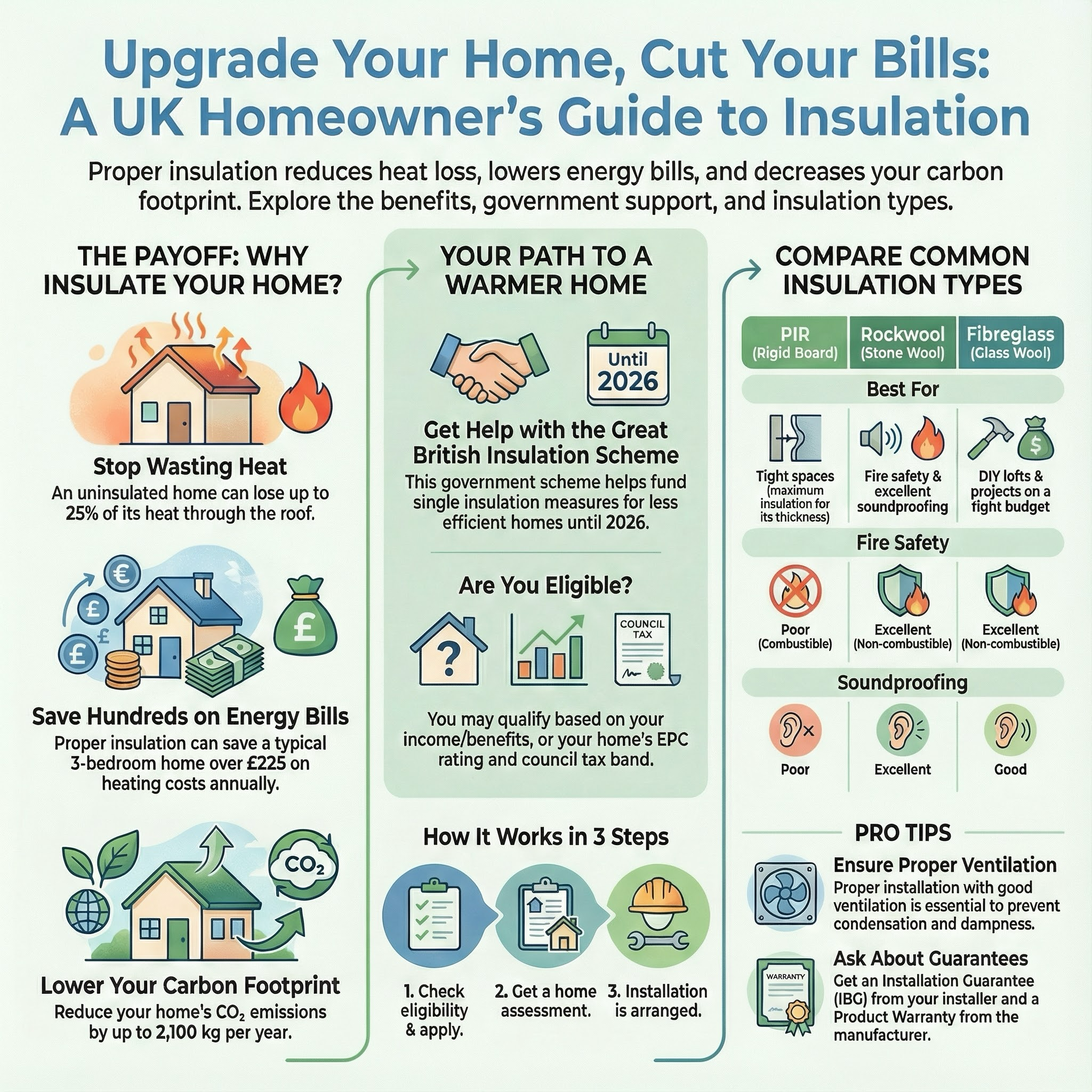
Insulation explained
The Great British Insulation Scheme (GBIS) ends 31 March 2026. £1 billion programme. Loft and cavity wall insulation free or heavily subsidised for qualifying UK households. After GBIS: ECO4 only until 31 Dec 2026, then Warm Homes Plan from 2027. Expect to pay £0–£1,500 for UK GBIS-funded insulation.
TrustMark or PAS 2030 installer. Free home assessment. Loft insulation top-up to 270mm. Cavity wall insulation. Some flat roof and underfloor. EPC D-G properties priority. Council Tax Band A-D eligibility.
| Item | Low (£) | High (£) | Notes |
|---|---|---|---|
| Loft insulation full GBIS | 0 | 0 | Free for qualifying |
| Cavity wall GBIS | 0 | 0 | Free for qualifying |
| Loft top-up market rate | 300 | 900 | Without GBIS |
| Cavity wall market rate | 500 | 1,500 | Without GBIS |
| Underfloor insulation | 1,500 | 4,000 | Suspended timber |
| External wall insulation | 8,000 | 20,000 | Not in GBIS scope |
| Annual energy saving estimate | 200 | 500 | Per year heating |
GBIS (Great British Insulation Scheme) March 2023 to 31 March 2026. ECO4 to 31 Dec 2026. Warm Homes Plan from 2027 (£13.2bn). PAS 2030/2035 retrofit standards.
31 March 2026 strict deadline. Works must complete by then.
Council Tax Band A-D in England, A-E Scotland/Wales. EPC D-G rated. Or benefits-receiving household.
ECO4 continues until 31 Dec 2026. Warm Homes Plan from Jan 2027 — £13.2bn budget.
Loft: 2-4 hours. Cavity wall: 4-8 hours typically. Survey to install 4-8 weeks.
Through approved installers. Ofgem-registered. Free home survey first.
£200-£500/year heating saving. Plus EPC rating boost helps MEES C 2030 compliance.
This guide was written with AI assistance and is intended for general information only. Prices are estimates based on UK averages and may vary by region. Always get at least three quotes and consult a qualified professional before starting any work.
Ask follow-ups in plain English. The AI explains options, sequencing and what to ask the insulation — so you walk in informed.
UK homes lose approximately 25% of their heat through an uninsulated roof. Installing high-quality insulation is one of the most effective ways to lower your en...
READ GUIDE →GuideWhether you are dealing with noisy neighbours in a terraced house or trying to create a quiet home office, professional soundproofing is a transformative invest...
READ GUIDE →GuideSuspended timber floors are a common feature in UK homes built before the 1950s. While they provide necessary ventilation for the building's structure, they are...
READ GUIDE →GuideCavity wall insulation is one of the most cost-effective ways to improve your home’s energy efficiency. By filling the gap between your inner and outer walls, y...
READ GUIDE →GuideAcoustic panels have transitioned from professional recording studios into the heart of modern UK homes. As open-plan living and hard flooring become more preva...
READ GUIDE →GuideInternal wall insulation (IWI) is a transformative upgrade for the millions of UK homes built with solid walls, typically those constructed before 1930. Unlike ...
READ GUIDE →