Instant
01 · Ask
Ask the AI a follow-up
Got more questions about piling Rig Foundation Installation? Describe the bit you're unsure about — the AI explains options, sequencing and what to ask the groundworks.

CFA, driven or bored piles — for poor ground, restricted access or heavy structures.
You've read the brief on piling Rig Foundation Installation. Now lean on us to find the right groundworks — and stay in control of the job.
Got more questions about piling Rig Foundation Installation? Describe the bit you're unsure about — the AI explains options, sequencing and what to ask the groundworks.
Costs, timelines, pitfalls and the right questions to ask before any groundworks starts on piling Rig Foundation Installation.
Itemised quotes from up to 3 local groundworkss on piling Rig Foundation Installation — so you can compare like-for-like, not lump sums.
Ready when you are
Enter your postcode and get free quotes from local pros.
Four moves that separate a smooth job from a nightmare.
Many UK terraced or semi-detached homes have narrow access, requiring expensive "mini-rigs" that can fit through a doorway.
Old foundations, large boulders, or forgotten utilities can stall drilling and increase costs.
Driven piling can be very disruptive; neighbours may complain if work isn't managed within local council-permitted hours.
If the ground is particularly soft or "vuggy," you may use significantly more concrete than quoted, leading to extra charges.
Indicative UK ranges and what affects price.
By job type
Quote spread is typically ± 18% — always get 3 quotes.
Groundworks quick-view
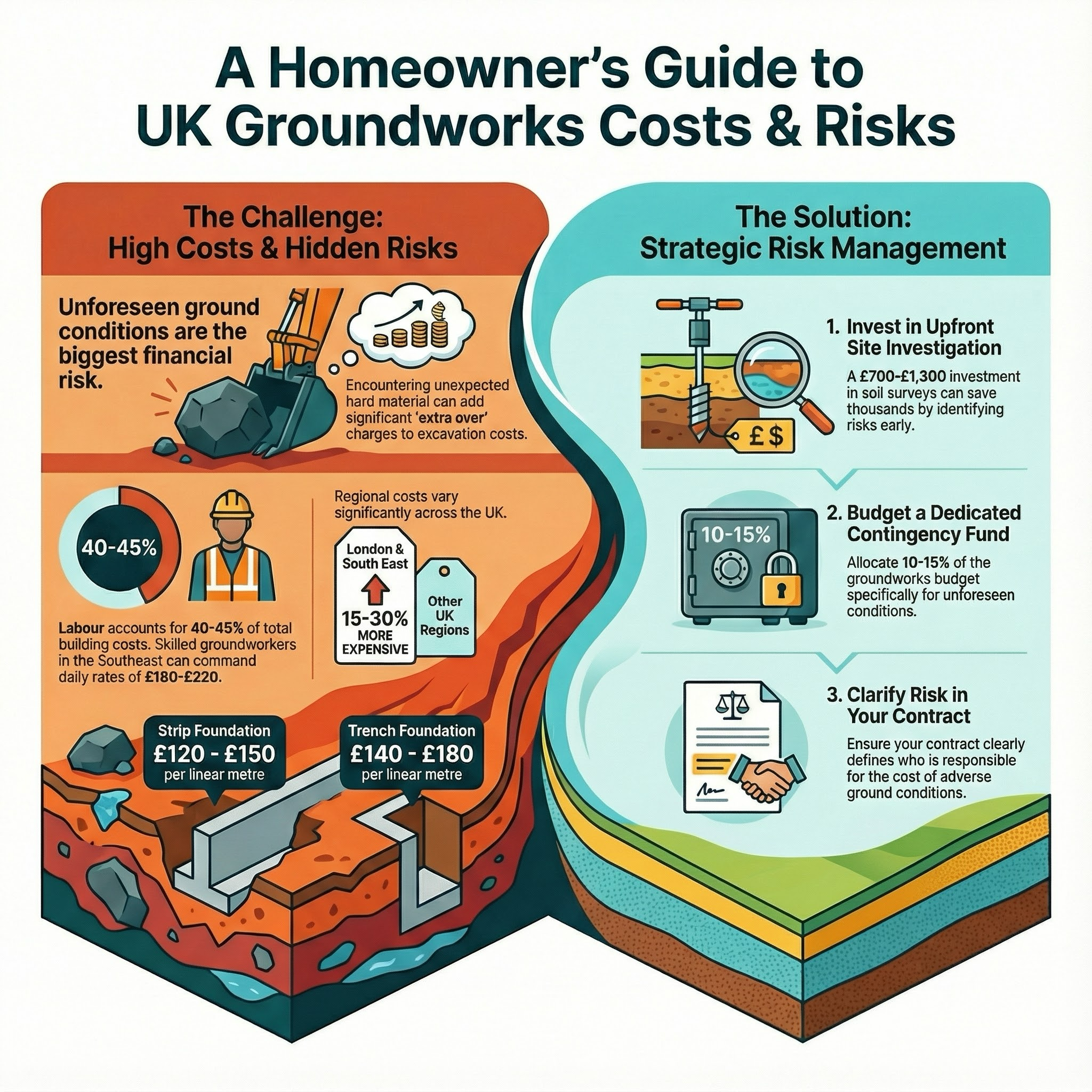
Groundworks explained
While more expensive than traditional methods, a piled foundation provides peace of mind by transferring the building's load to more stable strata deep underground. This guide outlines the costs, processes, and regulations involved in a domestic piling project.
Piling costs are heavily influenced by the "mobilisation" fee—the cost of getting the heavy machinery to your door. Expect to pay more for restricted access sites where smaller, specialised "mini-piling" rigs are required.
| Item | Low £ | High £ | Notes |
|---|---|---|---|
| Rig Mobilisation / Set-up | £650 | £1,800 | Fixed cost to bring equipment to site. |
| Cost Per Pile (approx. 5-8m) | £350 | £750 | Depends on diameter and soil type. |
| Structural Engineer Design | £500 | £1,200 | Required for Building Regs approval. |
| Reinforced Ground Beams (per m) | £150 | £250 | The horizontal support on top of piles. |
| Total Project (Small Extension) | £4,500 | £9,500 | Typical 15-20m² footprint. |
Prices include VAT at 20%. Factors such as the proximity of neighbouring buildings, the presence of underground utilities, and the specific depth required by the structural engineer will dictate the final quote.
Piling is strictly a professional-only task. It requires heavy, specialised machinery and precise engineering calculations to ensure the structural integrity of your home.
Attempting to bypass professional piling when specified by an engineer can lead to catastrophic structural failure, subsidence, and the invalidation of your home insurance.
You must hire a specialist contractor who can provide a "log" for every pile driven or bored, which will be required by your local Building Control officer for final sign-off.
If your soil is soft, peat-based, or full of clay, a standard 1-metre trench may not be stable enough. A structural engineer will make this call after reviewing a trial hole or borehole sample.
Driven piling (hammering) is very loud and causes vibrations. Bored piling (drilling) is much quieter and generally preferred in residential areas to minimise the risk of damage to neighbouring homes.
While rare, vibrations can cause minor cosmetic cracks. This is why a "Schedule of Condition" (photos of the neighbour's house before work starts) is highly recommended as part of a Party Wall Agreement.
Mini-piling uses smaller, often rubber-tracked rigs designed for sites with limited headroom or narrow access. It is the most common method for domestic UK extensions.
No. You must wait for the concrete in the piles and the subsequent ground beams to reach sufficient strength, which usually takes at least 7 to 10 days.
This guide was written with AI assistance and is intended for general information only. Prices are estimates based on UK averages and may vary by region. Always get at least three quotes and consult a qualified professional before starting any work.
Ask follow-ups in plain English. The AI explains options, sequencing and what to ask the groundworks — so you walk in informed.
Foundation issues are among the most significant concerns for UK homeowners. Whether caused by subsidence, heave, or historical poor construction, ensuring your...
READ GUIDE →GuideEmergency stabilisation works are the critical first response to sudden structural failure or ground instability. Whether caused by extreme weather, a burst wat...
READ GUIDE →GuideQuality topsoil is the biological engine of any healthy UK garden. Whether you are preparing for a new lawn, building raised beds, or levelling a tired landscap...
READ GUIDE →GuideUnderpinning is a critical structural intervention used to strengthen and stabilise a property's foundations. It is most commonly required when a building’s ori...
READ GUIDE →GuideA leaking kitchen sink is one of the most common domestic headaches for UK homeowners. While a small drip might seem minor, it can quickly lead to blown kitchen...
READ GUIDE →GuideUnderpinning is a critical structural intervention used to strengthen and stabilise the foundations of a property. For UK homeowners, this is typically necessar...
READ GUIDE →