Instant
01 · Ask
Ask the AI a follow-up
Got more questions about retaining Wall Construction? Describe the bit you're unsure about — the AI explains options, sequencing and what to ask the groundworks.

Concrete block, brick, gabion, sleeper or stone retaining wall — designed to ground pressure and height.
You've read the brief on retaining Wall Construction. Now lean on us to find the right groundworks — and stay in control of the job.
Got more questions about retaining Wall Construction? Describe the bit you're unsure about — the AI explains options, sequencing and what to ask the groundworks.
Costs, timelines, pitfalls and the right questions to ask before any groundworks starts on retaining Wall Construction.
Itemised quotes from up to 3 local groundworkss on retaining Wall Construction — so you can compare like-for-like, not lump sums.
Ready when you are
Enter your postcode and get free quotes from local pros.
Four moves that separate a smooth job from a nightmare.
Soil pressure builds, wall fails. Weep holes and gravel drainage essential.
Wall foundation too narrow. Spread load with adequate base.
Block gravity wall on weak soil = failure. Use cantilever or pile-supported.
Wall position critical. Survey before construction.
Indicative UK ranges and what affects price.
By job type
Quote spread is typically ± 18% — always get 3 quotes.
Groundworks quick-view
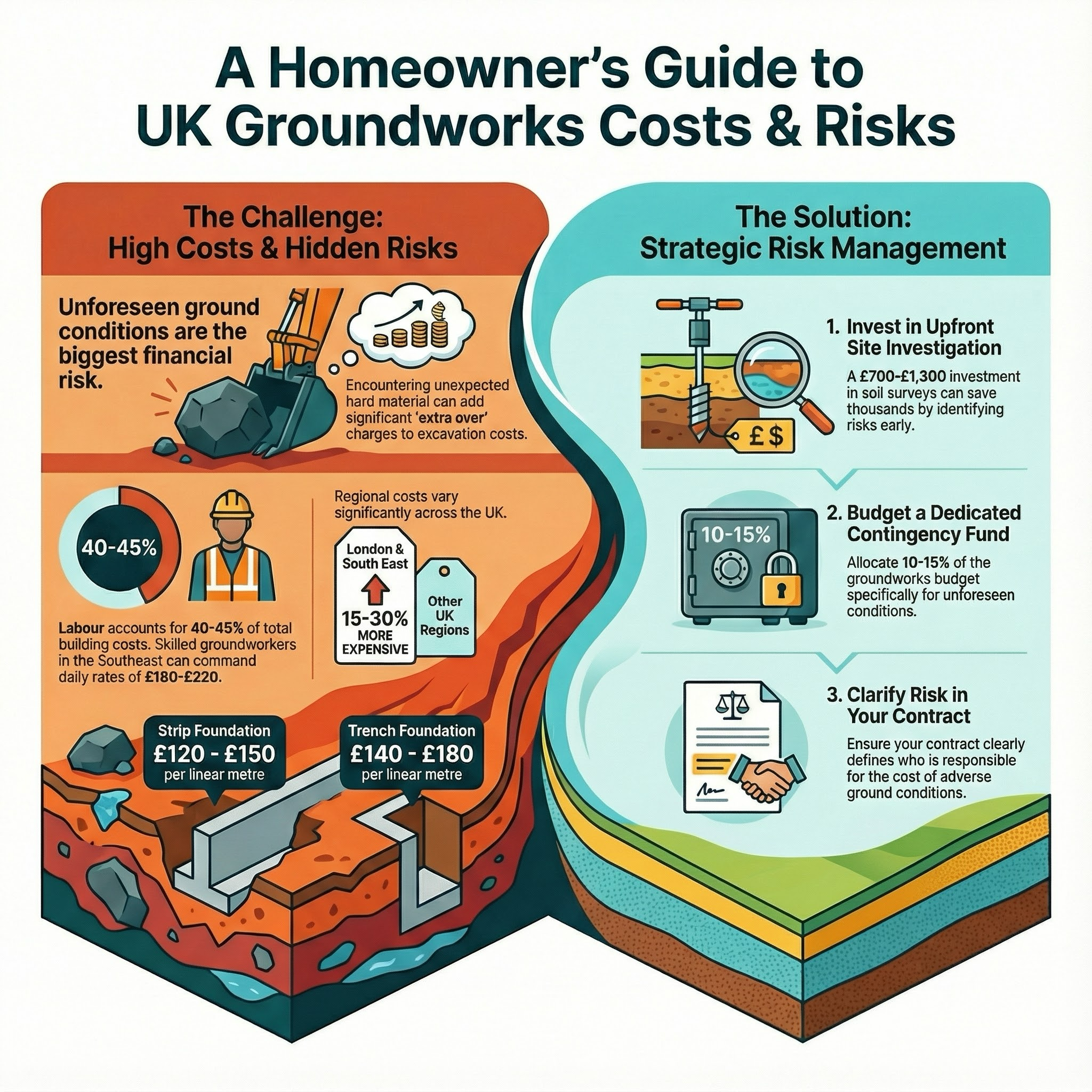
Groundworks explained
Retaining walls hold back earth on sloping ground. Several types depending on height and material. Expect to pay £150–£500 per metre for UK retaining wall, depending on height and material.
Structural engineer designs wall for soil pressure and height. Excavation to firm soil. Foundation footing. Wall built: gravity wall (mass concrete or block), cantilever (reinforced concrete L-shape), gabion (wire baskets of stone), sheet piling (steel sheets), or stone wall (heritage). Drainage essential behind wall.
| Item | Low (£) | High (£) | Notes |
|---|---|---|---|
| Block/brick gravity wall per metre | 150 | 300 | 1.5m height |
| Reinforced concrete cantilever | 250 | 500 | Per metre, premium |
| Gabion wall per metre | 200 | 400 | Stone-filled cages |
| Sheet pile per metre | 300 | 800 | Steel piling |
| Heritage stone wall per metre | 250 | 700 | Cotswold or Yorkstone |
| Standard 5m retaining wall | 1,500 | 3,500 | 1.5m height |
| Large retaining wall (2m+) | 3,500 | 15,000+ | Per project |
Standard 5m wall: 1-2 weeks. Larger: 2-4 weeks.
Specialist groundworker or builder. Structural engineer for any wall over 1m. Building Regs notification.
NFB member with retaining wall experience. Structural engineer design. APL for premium garden walls.
Building Regs Part A (structural). Building inspector approval for walls over 1m. Boundary walls may need planning permission. Listed buildings need consent.
Under 1m: possible. Over 1m: professional with structural calc. Soil pressure significant.
1m and under: brick/block gravity. 1-2m: reinforced concrete cantilever. 2m+: sheet pile or anchored systems. Structural engineer designs.
Yes — weep holes through wall. Gravel drainage behind wall. Without: hydrostatic pressure builds up.
Heritage requirements often demand stone walls (Cotswold, Yorkstone). Consent required.
Quality concrete/brick: 50-100+ years. Stone: 100+ years. Gabion: 30-50 years.
Sometimes re-grading cheaper than retaining wall. Compare scenarios.
This guide was written with AI assistance and is intended for general information only. Prices are estimates based on UK averages and may vary by region. Always get at least three quotes and consult a qualified professional before starting any work.
Ask follow-ups in plain English. The AI explains options, sequencing and what to ask the groundworks — so you walk in informed.
Foundation issues are among the most significant concerns for UK homeowners. Whether caused by subsidence, heave, or historical poor construction, ensuring your...
READ GUIDE →GuideEmergency stabilisation works are the critical first response to sudden structural failure or ground instability. Whether caused by extreme weather, a burst wat...
READ GUIDE →GuideQuality topsoil is the biological engine of any healthy UK garden. Whether you are preparing for a new lawn, building raised beds, or levelling a tired landscap...
READ GUIDE →GuideUnderpinning is a critical structural intervention used to strengthen and stabilise a property's foundations. It is most commonly required when a building’s ori...
READ GUIDE →GuideA leaking kitchen sink is one of the most common domestic headaches for UK homeowners. While a small drip might seem minor, it can quickly lead to blown kitchen...
READ GUIDE →GuideUnderpinning is a critical structural intervention used to strengthen and stabilise the foundations of a property. For UK homeowners, this is typically necessar...
READ GUIDE →