Instant
01 · Ask
Ask the AI a follow-up
Got more questions about external Solid Wall Insulation? Describe the bit you're unsure about — the AI explains options, sequencing and what to ask the insulation.

EWI — 100-200mm insulation fitted to the outside of solid walls, then rendered or clad. Major efficiency upgrade.
You've read the brief on external Solid Wall Insulation. Now lean on us to find the right insulation — and stay in control of the job.
Got more questions about external Solid Wall Insulation? Describe the bit you're unsure about — the AI explains options, sequencing and what to ask the insulation.
Costs, timelines, pitfalls and the right questions to ask before any insulation starts on external Solid Wall Insulation.
Itemised quotes from up to 3 local insulations on external Solid Wall Insulation — so you can compare like-for-like, not lump sums.
Ready when you are
Enter your postcode and get free quotes from local pros.
Four moves that separate a smooth job from a nightmare.
If insulation isn't returned into window reveals, cold spots remain, often leading to localized mould growth inside the house.
Failing to properly extend windowsills or roof eaves leads to water ingress behind the insulation boards.
Using cheap, non-breathable renders or skipping the mesh reinforcement layer will cause the exterior to crack within 2-3 years.
Installers must ensure that sub-floor air bricks and weep holes are not covered, as this can cause timber floors to rot.
Indicative UK ranges and what affects price.
By job type
Quote spread is typically ± 18% — always get 3 quotes.
Insulation quick-view
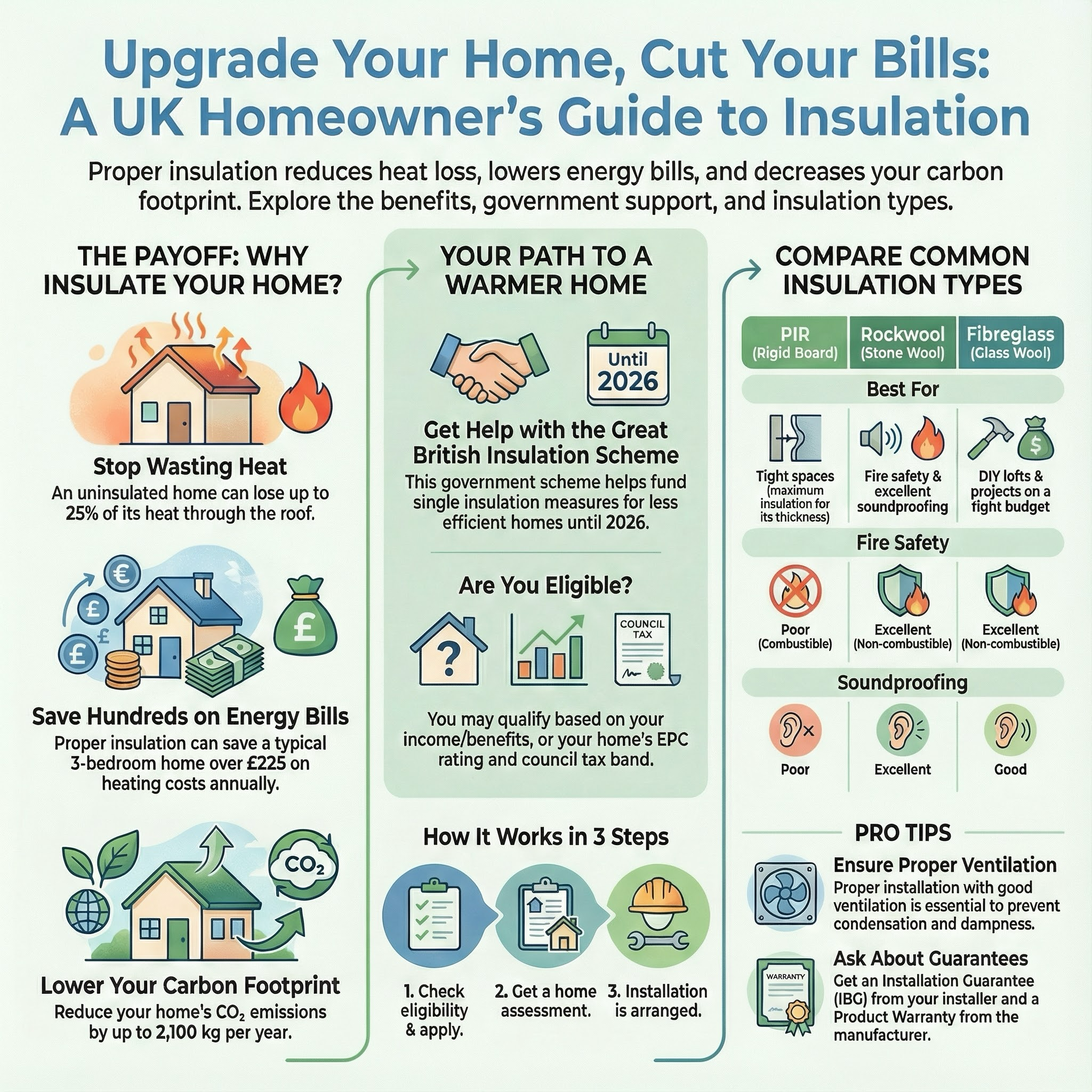
Insulation explained
Beyond thermal performance, EWI protects the fabric of your building from the British weather and can completely refresh a tired exterior. It is a major investment that requires specialist installers, but it is often the only way to significantly improve the EPC rating of an older property.
| Property Type | Low £ | High £ | Notes |
|---|---|---|---|
| Small Mid-Terrace | £7,500 | £10,500 | Front and back elevations only. |
| Semi-Detached House | £12,000 | £16,000 | Includes scaffolding and three elevations. |
| Large Detached House | £18,000 | £28,000+ | Varies significantly by m² and complexity. |
| Per Square Metre (m²) | £100 | £160 | Inclusive of materials, labour, and VAT. |
The total cost is primarily driven by the surface area of the walls and the complexity of the architectural details. Scaffolding hire, which can cost between £800 and £3,000 depending on the project duration, is a significant factor, as is the choice of insulation material—mineral wool is more expensive than EPS but offers better fire resistance and breathability.
External wall insulation is strictly a professional job. It involves complex structural calculations, specialist rendering techniques, and working at height. Incorrect installation can lead to "interstitial condensation," where moisture is trapped inside the wall, causing structural rot and severe damp issues.
To qualify for government grants or to ensure the work is compliant with Building Regulations, the installation must be carried out by a certified professional and registered with a body like the Solid Wall Insulation Guarantee Agency (SWIGA).
Yes. EWI adds roughly 100mm–150mm to the thickness of your walls. While the finish is a clean, modern render, it will change the depth of your window reveals and may alter the character of period properties.
Schemes like the ECO4 or the Great British Insulation Scheme often provide full or partial funding for low-income households or properties with low EPC ratings. Check with your local council or Energy Saving Trust.
If installed correctly with breathable materials, it actually solves many damp issues by keeping the internal wall surface warm. However, poor installation that blocks ventilation can lead to new damp problems.
It is difficult. Most renders require a temperature of at least 5°C to set. While the boards can be fixed in the cold, the final "wet" stages are usually reserved for the spring and summer months.
A professionally installed EWI system is designed to last at least 30 years. Most reputable installers provide a 25-year insurance-backed guarantee as standard.
This guide was written with AI assistance and is intended for general information only. Prices are estimates based on UK averages and may vary by region. Always get at least three quotes and consult a qualified professional before starting any work.
Ask follow-ups in plain English. The AI explains options, sequencing and what to ask the insulation — so you walk in informed.
UK homes lose approximately 25% of their heat through an uninsulated roof. Installing high-quality insulation is one of the most effective ways to lower your en...
READ GUIDE →GuideWhether you are dealing with noisy neighbours in a terraced house or trying to create a quiet home office, professional soundproofing is a transformative invest...
READ GUIDE →GuideSuspended timber floors are a common feature in UK homes built before the 1950s. While they provide necessary ventilation for the building's structure, they are...
READ GUIDE →GuideCavity wall insulation is one of the most cost-effective ways to improve your home’s energy efficiency. By filling the gap between your inner and outer walls, y...
READ GUIDE →GuideAcoustic panels have transitioned from professional recording studios into the heart of modern UK homes. As open-plan living and hard flooring become more preva...
READ GUIDE →GuideInternal wall insulation (IWI) is a transformative upgrade for the millions of UK homes built with solid walls, typically those constructed before 1930. Unlike ...
READ GUIDE →