Instant
01 · Ask
Softener, filter or full treatment?
Hard water marks, smells, private supply — describe the issue and the AI tells you what kind of system you need.

Water softeners, filters, purification and testing — quoted with grain capacity and salt usage.
Read the brief on testing, WRAS approval and maintenance — then let Three local specialists quote.
Hard water marks, smells, private supply — describe the issue and the AI tells you what kind of system you need.
Water test reports, WRAS-approved kit, bypass valves, salt consumption, UV bulb life. Know what to ask.
Three local specialists quote on the same diagnosis — system, install, maintenance — so the soft water lasts.
Ready when you are
Enter your postcode and get free quotes from local pros.
Four moves that separate a smooth job from a nightmare.
Hard water, iron, chlorine, bacteria — each needs different treatment. Insist on a water test before the installer recommends a system.
Any equipment touching drinking water must be WRAS approved. Cheaper kit often isn't — and Building Control will flag it.
Softener installations should have a bypass for raw water (gardening, drinking water). Without a bypass, you're softening every drop unnecessarily.
Filter cartridges, salt, UV bulbs — annual running cost can match the install. Get the maintenance schedule and cost in writing before signing.
Indicative UK ranges and what affects price.
By job type
Quote spread is typically ± 18% — always get 3 quotes.
Visual breakdown of costs, timelines and the questions you should be asking.
Water Treatment quick-view
Water Treatment explained
Everything you need to know before hiring a water treatment.
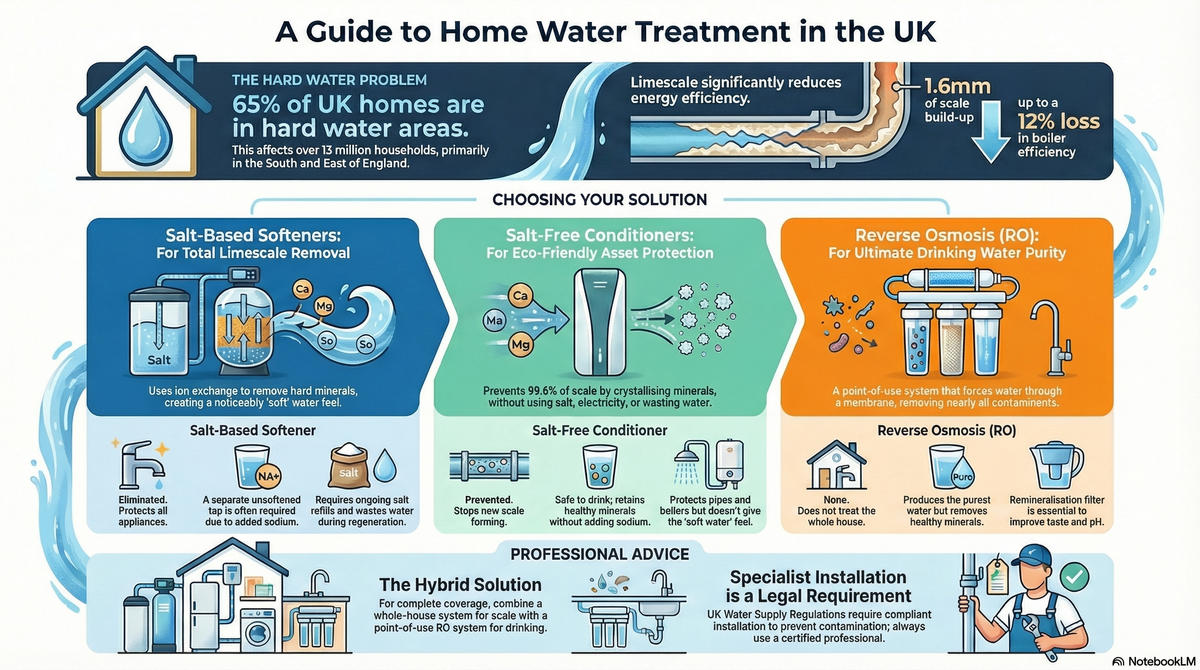
Water treatment specialists are essential for UK homeowners looking to improve the quality of their domestic water supply. Whether you are dealing with the chalky limescale common in Southern and Eastern England or concerned about impurities in a private well, these professionals provide the technical expertise to make your water safer, softer, and better tasting.
A specialist doesn't just "fit a filter"; they diagnose specific water chemistry issues and install systems that protect your plumbing, appliances, and skin. From whole-house water softeners to advanced Reverse Osmosis (RO) systems, they ensure your home’s most vital utility meets the highest standards.
Working with a water treatment professional typically follows a structured process to ensure the system installed is fit for your specific local water conditions and household usage.
While basic jug filters are simple, whole-house systems involve complex plumbing and must comply with the Water Supply (Water Fittings) Regulations 1999. An incorrect installation can lead to cross-contamination of the mains supply or significant water damage from high-pressure leaks.
Professionals ensure that all components are WRAS (Water Regulations Advisory Scheme) approved, meaning they won't leach harmful chemicals into your drinking water. Furthermore, a specialist can accurately calculate your household’s peak flow rate; an undersized softener will lead to "hard water breakthrough" and a waste of money.
For those on private water supplies, such as boreholes or springs, hiring a professional is a legal and health necessity. They install UV sterilisation and iron reduction systems that ensure your water is bacteriologically safe to drink.
Prices for water treatment vary significantly based on the technology used and the complexity of your existing plumbing. Below are realistic estimates for 2025/26, including VAT and professional installation.
| Service | Low £ | High £ | Notes |
|---|---|---|---|
| Electric Water Softener | £800 | £1,600 | Includes installation and bypass kit. |
| Non-Electric (Twin Tank) Softener | £1,200 | £2,000 | Higher upfront cost, lower maintenance. |
| Under-Sink Reverse Osmosis | £350 | £750 | Provides ultra-pure drinking water. |
| Whole-House Filtration | £500 | £1,500 | Removes chlorine and sediment. |
| UV Sterilisation System | £600 | £1,200 | Essential for private/well supplies. |
| Annual Service & Filter Change | £100 | £250 | Excludes the cost of replacement parts. |
Cost Factors: The main drivers of price include the brand of the unit, the distance from the rising main to a suitable drain, and whether any additional power sockets need to be installed by an electrician.
Not all plumbers are water treatment experts. To find a qualified professional, look for specific experience in water chemistry and filtration technology.
Questions to ask before hiring:
A water softener specifically removes calcium and magnesium ions that cause limescale through a process called ion exchange. A water filter removes impurities like chlorine, lead, and bacteria to improve taste and safety, but it does not usually "soften" the water or prevent limescale.
Yes, it is standard practice to leave at least one kitchen tap on un-softened water. This is because softened water contains slightly higher levels of sodium, which may not be suitable for infants or those on low-sodium diets, and many people prefer the taste of natural mains water for drinking.
Standard sediment and carbon filters usually need changing every 6 to 12 months, depending on usage. UV bulbs, which kill bacteria in private supplies, typically have a lifespan of about 9,000 hours (roughly one year) and must be replaced even if they still appear to be glowing.
Yes. Over time, softened water will gradually dissolve existing limescale deposits in your pipes, boiler heat exchanger, and appliances. You may notice a temporary increase in debris in your tap aerators as this old scale breaks away and is flushed out.
Describe the job in plain English. The AI asks a few smart questions, then tells you whether a water treatment is the right call, what it should cost, and what to ask before they start.
Limescale removal services. UK costs.
READ GUIDE →GuideHard water affects over 60% of UK households, particularly in the South and East of England. High concentrations of calcium and magnesium lead to limescale buil...
READ GUIDE →GuideWater softener install. UK costs.
READ GUIDE →Borehole drilling and private water. UK costs.
READ GUIDE →GuideUpgrading your home’s water quality is a smart investment for both your health and the longevity of your appliances. Whether you are looking to remove the taste...
READ GUIDE →Whole house water filtration. UK costs.
READ GUIDE →GuideMaintaining your home water filtration system is essential for ensuring the continued safety, taste, and clarity of your drinking water. In many parts of the UK...
READ GUIDE →